 When an operator mistakenly overpays a royalty owner, it can recoup the overpayment from future royalties. While this is a common industry practice, the doctrine of equitable recoupment is seldom discussed in detail by Texas courts. Continue Reading]]>
When an operator mistakenly overpays a royalty owner, it can recoup the overpayment from future royalties. While this is a common industry practice, the doctrine of equitable recoupment is seldom discussed in detail by Texas courts. Recently, however, the Fifth Circuit provided an in-depth overview of the doctrine of equitable recoupment in its opinion affirming a district court decision from the Western District of Texas in DDR Weinert, Ltd. v. Ovintiv USA, Inc.
The dispute centered on whether Ovintiv USA, Inc. (“Ovintiv”), the operator and lessee, was permitted to recoup overpayments that were made two years prior to a prior lessor (“the Richters”) from the successor lessors, DDR Weinert, Ltd. and DDR Williams, Ltd. (“Plaintiffs”), two entities owned and controlled by the Richters. The Richters owned several tracts of land in Karnes County, Texas (the “Subject Property”), and Ovintiv was the lessee and operator of the Subject Property. In December 2017, the Richters conveyed their mineral interests in Subject Property to the Plaintiffs. As such, the Plaintiffs became the successor lessors of the Subject Property.
In September 2016, Ovintiv mistakenly adjusted the gas flow on the Subject Property; this error resulted in Ovintiv overpaying the Richters royalties. Ovintiv did not discover its error until January 2018. Once Ovintiv discovered the mistake, it notified Plaintiffs that “it planned to conduct a ‘Prior Period Adjustment’ that year and would recoup any overpayments to the Richters from future royalty payments to the Plaintiffs.” Plaintiffs sued Ovintiv in Texas state court on April 27, 2022, alleging that Ovintiv withheld over $608,000 in royalties from them. On the basis of diversity jurisdiction, Ovintiv removed the lawsuit to the Western District of Texas, and the district court granted summary judgment for Ovintiv. Plaintiffs appealed, and the Fifth Circuit affirmed. The Fifth Circuit’s decision focused on the doctrine of equitable recoupment.
The Fifth Circuit explained that for the doctrine of equitable recoupment to apply, two requirements must be met: “‘(1) some type of overpayment must have been made, and (2) both the creditor’s claim and the amount owed the debtor must arise from a single transaction.’” Neither party disputed that an overpayment was made; thus, the Fifth Circuit only considered whether the overpayment arose “from a single transaction.”
Guided in large part by one of its previous rulings, W & T Offshore Inc. v. Bernhardt, F.3d 227, 241 (5th Cir. 2019), and a seminal Texas Supreme Court case, Gavenda v. Strata Energy, Inc., 705 S.W.2d 690, 692 (Tex. 1986), the Fifth Circuit concluded that Ovintiv’s overpayment arose from a single transaction and, thus, the doctrine of equitable recoupment barred the Plaintiffs’ claims. In W & T Offshore Inc., the Fifth Circuit held that, for recoupment purposes, each monthly payment under a lease is part of the same transaction; applying that ruling here, the Fifth Circuit concluded that Ovintiv’s overpayment of royalties arose from a single transaction. Next, relying on Gavenda, the Court examined whether application of doctrine of equitable recoupment would prevent Ovintiv from being unjustly enriched. The Court reasoned that if the Plaintiffs were to succeed, “Ovintiv ‘would pay the amount of overpayment twice—once to the overpaid royalty owner . . . and again to the [Plaintiffs] through [t]his suit.’” Two facts of particular importance were that (1) Ovintiv did not profit from underpaying the Plaintiffs and (2) the Plaintiffs are entities controlled by the Richters. Thus, if the Plaintiffs were to prevail, both the Richters and Plaintiffs would be unjustly enriched. The Court also noted that the Plaintiffs could bring a claim for unjust enrichment against the Richters. Therefore, the Fifth Circuit concluded that the doctrine of equitable recoupment applied and estopped the Plaintiffs’ claims against Ovintiv.
For more information about how recent rulings may affect royalty interests or operational practices, contact Liskow attorneys Jana Grauberger, James Kittrell, and Margaret Chavez, and visit our Royalty Litigation practice page.
]]> On April 8, 2025, President Trump issued an Executive Order (EO), “Protecting American Energy From State Overreach,” aimed at “unleashing American energy” by directing the U.S. Attorney General (AG) to identify state laws and policies that burden the development of domestic energy resources and “are or may be unconstitutional, preempted by Federal law, or otherwise... Continue Reading]]>
On April 8, 2025, President Trump issued an Executive Order (EO), “Protecting American Energy From State Overreach,” aimed at “unleashing American energy” by directing the U.S. Attorney General (AG) to identify state laws and policies that burden the development of domestic energy resources and “are or may be unconstitutional, preempted by Federal law, or otherwise unenforceable.” The EO directs the AG to prioritize state law purporting to address “climate change” or involving “environmental, social, and governance” initiatives, “environmental justice,” carbon or “greenhouse gas” emissions, and funds to collect carbon penalties or carbon taxes.
The EO is broadly written and may encompass a wide variety of state laws that address the above topics, but it does provide specific examples that may be targeted. For instance, the EO identifies New York and Vermont’s “climate superfund” laws, which seek to collect billions of dollars from fossil fuel companies to pay for climate-change infrastructure projects and other related expenses, as “burdensome and ideologically motivated.” In addition to New York and Vermont’s existing climate superfund laws, several other states, including California, Maryland, Massachusetts, New Jersey, and Oregon, have been considering adopting similar legislation. The EO also cites California’s mandatory cap-and-trade program, which sets a limit on greenhouse gas emissions and allows companies to trade emissions allowances with each other, as a “radical” state approach to dictate national energy policy. Further, the EO targets tort actions brought by various states against energy companies for “climate change damages,” which could be “crippling.”
“These State laws and policies weaken our national security and devastate Americans by driving up energy costs for families coast-to-coast, despite some of these families not living or voting in States with these crippling policies[,]” the EO states. As such, the EO directs the AG to “expeditiously take all appropriate action” to halt the enforcement and continuation of civil actions associated with these state laws. The EO also directs the AG to, within 60 days from the date of the order, submit a report to the President regarding actions taken in response to the order’s directives. Finally, the EO directs the AG to recommend any additional action necessary to halt the enforcement of these kinds of state laws.
Liskow will be monitoring for any legal challenges and other updates resulting from this EO. For more information on the new administration’s energy policies and potential industry impacts, please contact Liskow attorneys Greg Johnson, Clare Bienvenu, and Colin North, and visit our Environmental Regulatory practice page.
]]> On this episode of "Energy Law This Week", Liskow attorneys Matt Jones and April Rolen-Ogden delve into the complexities of federal offshore issues by focusing on the jurisdictional foundation, the leasing processes, environmental regulations, and the implications of political changes on offshore operations. Continue Reading]]>
On a recent episode of “Energy Law This Week ,” Matt Jones , April Rolen-Ogden, and Jana Grauberger delve into the complexities of federal offshore issues by focusing on the jurisdictional foundation, the leasing processes, environmental regulations, and the implications of political changes on offshore operations. The discussion highlights the challenges posed by decommissioning obligations, financial assurances, and the impact of environmental concerns, particularly regarding the endangered Rice’s whale.
Listen to the full episode on the Oil & Gas Global Network here.
]]> On April 9, 2025, the United States Court of Appeals for the Fifth Circuit held that faith- and community-based groups1 (the “Groups”) representing certain residents of St. James Parish, Louisiana, may continue with their suit seeking a moratorium on the construction and expansion of industrial facilities in the Parish. See Inclusive Louisiana v. St. James... Continue Reading]]>
On April 9, 2025, the United States Court of Appeals for the Fifth Circuit held that faith- and community-based groups1 (the “Groups”) representing certain residents of St. James Parish, Louisiana, may continue with their suit seeking a moratorium on the construction and expansion of industrial facilities in the Parish. See Inclusive Louisiana v. St. James Parish, No. 23-30908 (5th Cir. 2025).
The Groups originally sued St. James Parish in federal district court in March 2023, alleging that the Parish discriminates against them by directing hazardous industrial facility development towards majority-Black districts and Black churches where their members and congregants live. Additionally, the Groups argued that the Parish authorizes industrial development that destroys and restricts access to the cemeteries of their enslaved ancestors. As such, the Groups brought seven claims for violations of their constitutional and statutory civil rights, seeking, among other things, a judgment declaring the Parish’s policies, patterns, and customs of discriminatory land use are violative of the Groups rights and injunctive relief enjoining the Parish from siting more industrial facilities in the majority-Black districts.
In November 2023, Judge Carl Barbier of the Eastern District of Louisiana dismissed the Groups’ claims for a variety of reasons. Most notably, the district court dismissed two of the Groups’ claims for lack of standing on the basis that, because the inaccessibility of the cemeteries was due to third parties, the Groups’ alleged religious injuries were not “fairly traceable” to the Parish. The district court dismissed the other five claims on the grounds that such claims were based on a single discrete incident in the past—the Parish’s adoption of its alleged “facially discriminatory” Land Use Plan in 2014—and thus, were time barred due to a one-year statute of limitations period within which the Groups did not bring their claims. The Groups then timely appealed the district court’s opinion to the Fifth Circuit, which reversed the district court.
The Fifth Circuit panel, consisting of Judges Carl Stewart, Catharina Haynes, and Patrick Higginbotham, agreed with the Groups’ argument that they had pleaded enough facts to allege that the adoption of the 2014 Land Use Plan was not a single, discrete action giving rise to their claims, but was rather pled to be a part of the “longstanding pattern and practice of racially discriminatory land use decisions” where “at least one act in this pattern and practice occurred within the limitations period.” The Fifth Circuit relied on certain of the Groups’ pleaded acts occurring within the one-year limitation period to come to this conclusion, including the Parish’s August 2022 decision to reject the Groups’ request for a mortarium on “polluting industry” in their majority-Black communities. The Fifth Circuit also agreed with the Groups’ argument that their religious injuries could stem from the Parish’s land use practices that authorized the alleged destruction of the cemeteries. Accordingly, the Fifth Circuit remanded the case back to the district court for further proceedings consistent with its opinion.
In closing, the Fifth Circuit noted that the Groups have standing to pursue their claims, but whether the Groups will prove the allegations or prevail on any of their claims, “remains to be seen.” Liskow will be monitoring and covering further developments in these proceedings. For more information on these proceedings and potential industry impacts, please contact Liskow attorneys Greg Johnson, Clare Bienvenu, and Colin North, and visit our Environmental Regulatory practice page.
1 The three groups include Inclusive Louisiana, Mount Triumph Baptist Church, and RISE St. James.
]]> In 2024, the Bureau of Ocean Energy Management (“BOEM”) issued new financial assurance (“FA”) regulations requiring an estimated $6.9 billion in new supplemental FA from federal offshore oil and gas lessees and grantees, all in excess of base-level bonding amounts (the “Rule”). Continue Reading]]>
In 2024, the Bureau of Ocean Energy Management (“BOEM”) issued new financial assurance (“FA”) regulations requiring an estimated $6.9 billion in new supplemental FA from federal offshore oil and gas lessees and grantees, all in excess of base-level bonding amounts (the “Rule”).1 Gulf states and certain trade groups sued in State of Louisiana, et al. v. Haaland, et al., No. 2:2024-cv-00820 (filed June 17, 2024 W.D. La.), challenging the Rule as unlawful and seeking vacatur. Plaintiffs sought a preliminary injunction or stay in the interim to prevent BOEM from enforcing the Rule while the litigation is pending. On March 10, 2025, the U.S. District Court for the Western District of Louisiana denied the plaintiffs’ motion for preliminary injunction or stay for failure to prove the threat of irreparable harm, as well as due to unresolved issues requiring a contradictory hearing that prevented the court from finding plaintiffs have a substantial likelihood of success on the merits.
At this time, BOEM is reviewing its Biden-era FA regulations and plans to announce the efforts it will take to suspend, revise, or rescind the Rule. This regulatory review is being undertaken in response to President Trump’s Executive Order 14154 § 3, Unleashing American Energy, issued Jan. 20, 2025 (“EO 14154”), 2 and U.S. Department of Interior Secretarial Order 3418 § 4(b), issued Feb. 3, 2025, implementing EO 14154. Considering the forthcoming BOEM announcement on the Rule, on April 7, 2025, the parties to the lawsuit filed a joint motion to stay further proceedings over the existing Rule, which was granted by the court (the “Stay”). Pursuant to the terms of the Stay, BOEM agreed to only seek supplemental FA covering select federal offshore properties:
Defendants are reviewing the Rule and anticipate announcing the efforts they will take to suspend, revise or rescind the Rule. . . . Defendants, consistent with their discretion under the Rule, agree not to seek supplemental financial assurance except in the case of (a) sole liability properties; and (b) those non-sole liability properties that are held by owners who are not financially strong (as described by the Rule) and that have no co-owners or predecessors who are financially strong (i) that are inactive, (ii) where the production end of life is fewer than five years, or (iii) with damaged infrastructure, regardless of the remaining property life of the surrounding producing assets.
Notably, this interim enforcement policy takes into consideration the financial strength, i.e., credit rating, of predecessors; whereas, the Rule considers the financial strength of only current co-lessees/grantees when making supplemental FA determinations. See 30 C.F.R. § 556.901(d)(3).
BOEM must provide a status report by Aug. 5, 2025, and at 90-day intervals thereafter. BOEM also agreed to provide a status report upon publication of a proposed or final rule affecting the existing Rule.
Liskow’s Energy Law Blog will continue to monitor and report on this ongoing litigation, where you can also see the firm’s prior posts on the mechanics of the existing Rule and filing of the lawsuit. Contact Liskow attorneys Jana Grauberger, Kathleen Doody, and Kyrie Buffa for more information on this topic, and visit the Federal Offshore Regulatory practice page on our website.
1Risk Management and Financial Assurance for OCS Lease and Grant Obligations, 89 Fed. Reg. 31544 (Apr. 24, 2024). The Rule went into effect on June 29, 2024. 89 Fed. Reg. 47080 (May 31, 2024)
2EO 1454, Unleashing American Energy, 90 Fed. Reg. 8353-59 (Jan. 29, 2025).
]]> In Corbello v. Iowa Prod. Co., 850 So. 2d 686 (La. 2003), the Louisiana Supreme Court recognized a “loophole” in the law where a landowner was allowed to recover millions in remediation damages for oilfield contamination without any requirement that the money be used for actual restoration. Continue Reading]]>
In Corbello v. Iowa Prod. Co., 850 So. 2d 686 (La. 2003), the Louisiana Supreme Court recognized a “loophole” in the law where a landowner was allowed to recover millions in remediation damages for oilfield contamination without any requirement that the money be used for actual restoration. In the wake of Corbello, the Legislature responded with the enactment of “Act 312,” La. R.S. 30:29, which governs the procedure in oilfield contamination cases. Act 312 ensures that money awarded for environmental damage is used to remediate the property to state regulatory standards while preserving a landowner’s private contractual rights. Landowners and defendants have fought for years over key provisions of Act 312 including: the availability of “additional remediation” damages above a regulatory cleanup, the scope of recoverable attorney’s fees, and the requirements of the “Most Feasible Plan” structured by the Louisiana Department of Energy and Natural Resources “LDENR.” The upcoming legislative session will tackle two bills addressing the future of Act 312 and legacy litigation. House Bill 602 proposes several amendments to Act 312 including: limitations on the recoverable damages, alternative options for a responsible party to fund the Most Feasible Plan, and restrictions on the recovery of attorney’s fees. House Bill 634 proposes a new administrative procedure which would replace Act 312 as of January 1, 2026. Under this proposal, claims alleging environmental damage must go through a new administrative process before litigation can proceed. That administrative ruling can be appealed to an administrative law judge, and the First Circuit Court of Appeal. The new procedure would mark a significant change from Act 312, which triggers the administrative process only after a party makes a limited admission of responsibility for environmental damage or the finder of fact determines a party or parties responsible for environmental damage.
For more information contact Liskow Attorneys Kelly Becker, Jamie Rhymes, and John Troutman, and stay tuned for future updates on Liskow’s The Energy Law Blog.
]]> The 2025 Louisiana Legislative Session will officially begin on Monday, April 14. Twenty bills have been filed on carbon capture sequestration in Louisiana. Continue Reading]]>
The 2025 Louisiana Legislative Session will officially begin on Monday, April 14. Twenty bills have been filed on carbon capture sequestration in Louisiana. The bills range from:
- allowing each parish to decide whether to allow CCS in its parish;
- eliminating eminent domain for all CCS pipelines;
- taxing CCS;
- increasing requirements and reporting on both CCS storage facilities and pipelines;
- requiring the compensation of mineral rights owners.
Read a brief overview of each proposed bill below:
House Bills:
- HB 4 (Owen) Local Option – each parish can vote on allowing CCS in its parish
- HB 75 (McCormick) Any pore space owner forced pooled/unitized will receive the highest compensation paid to any other owner
- HB 78 (Carrier) Local option for Allen Parish to choose CCS
- HB 250 & 251 (Owen) Local option for Vernon & Beauregard Parishes
- HB 304 (Carter) Expropriation hearings are to be held in parish where property is located
- HB 353 (Mack)
- (1) Adds requirement for a storage operator to receive a certificate of public convenience and necessity to show the lack of producing minerals below the storage reservoir;
- (2) Adds civil and criminal penalties if a storage operator does not provide required reports;
- (3) Requires emergency plan relating to CCS pipelines;
- (4) Requires storage operator and transporter to provide emergency equipment to local responders;
- (5) Requires storage operator to have financial security or insurance to protect public water systems
- (6) Adds strict liability to storage operator or transporter for any damages caused by unauthorized release of CO2
- (7) Prohibits injection wells and pipelines within 1/2 mile of homes, schools, heath care facilities, houses of worship;
- (8) Requires advance notice of construction of injection well or pipeline to all residences, business, and gov’t entities within 2-mile radius
- (9) Requires remediation plan for groundwater contamination
- (10) Requires continuous monitoring of all underground drinking water sources
- (11) Requires routine sampling and testing of public water system by a third party, upon request
- (12) Requires alternative potable drinking water within 24 hours and alternative water supply within 30 days if drinking water is contaminated
- HB 380 (Schamerhorn) Eliminates eminent domain for CCS storage and pipelines
- HB 396 (McCormick) Declares CCS illegal
- HB 444 (Mack) Establishes injection tax of $3 per metric ton for parish where CO2 is stored; also provides collection procedures
- HB 522 (McCormick) Places moratorium on CCS in Louisiana until July 1, 2026
- HB 537 (Schamerhorn) Creates a carbon dioxide pipeline victim lien for anyone within 25-mile radius of a pipeline release
- HB 552 (Schamerhorn) Levies an excise tax on CCS pipelines at 5 cents per mile for parish(es) where pipeline is located
- HB 553 (Schamerhorn) Eliminates eminent domain for CCS pipelines
- HB 568 (Carrier) Adds reporting requirements for CCS pipeline leaks, seismic activity related to CCS injections, and CCS equipment malfunction that could lead to a release; and related penalties for failure to report
- HB 585 (McCormick) Requires advance notice to all owners (surface, mineral, servitude, operators) within the AOR before a Class VI can be deemed administratively complete
- HB 601 (Geymann) Limits right of eminent domain for CCS pipelines to 5% of the proposed right of way (i.e, need 95% by consent to use eminent domain); Limits right of eminent domain to US companies; Requires additional upfront notice to landowners that eminent domain cannot be used without 95% consent by all owners; Requires the Commissioner to consider whether CCS pipeline considered alternative routes for non-consensual landowners before issuing certificate of convenience and necessity
- HB 632 (Riser) Requires CCS storage operators to obtain pore space agreements from mineral rights owners; Requires mineral rights owners to be included in the 75% minimum for unitization; Requires mineral rights owners to be compensated if forced pooled via unitization proceeding; Includes mineral right owners in notices required to be given to landowners by CCS companies
Senate Bills:
- SB 36 (Hensgens) Placeholder bill
- SSB 73 (Reese) Requires the Commissioner to give “substantial consideration to local government comments” when determining whether to issue a certificate of public convenience and necessity for a CCS storage facility or CCS pipeline
Liskow will continue to share regular updates throughout this session about CCS legislation on the 2025 CCS Legislative Update page from Liskow attorney and Louisiana Lobbyist Neil Abramson and CCS attorney Jeff Lieberman.
]]> On April 3, 2025, the Louisiana Department of Revenue published Revenue Information Bulletin No. 25-013 clarifying the proper sales and use tax treatment for rentals of cranes and other equipment with operators. Under Act 11 of the Third Extraordinary Session of 2024, the Louisiana Legislature repealed the statutory sales and use tax exclusion for the... Continue Reading]]>
On April 3, 2025, the Louisiana Department of Revenue published Revenue Information Bulletin No. 25-013 clarifying the proper sales and use tax treatment for rentals of cranes and other equipment with operators. Under Act 11 of the Third Extraordinary Session of 2024, the Louisiana Legislature repealed the statutory sales and use tax exclusion for the lease or rental of cranes and related equipment with operators. However, R.I.B. No. 25-013 makes clear that this repeal does not mean that all leases of cranes and other related equipment are taxable. The lease or rental of a crane and related equipment with an operator will be treated the same as other rentals of tangible personal property with operators for sales and use tax purposes.
Read the full post on The Gulf Coast Business Law Blog here.
]]> On April 3, 2025, the Louisiana Department of Energy and Natural Resources (LDENR), Office of Conservation, issued a Draft Permit prepared by the Injection and Mining Division for Hackberry Carbon Sequestration, LLC (HCS) to drill, construct, and operate a Class VI injection well for geologic sequestration of carbon dioxide in Cameron Parish, Louisiana. Continue Reading]]>
On April 3, 2025, the Louisiana Department of Energy and Natural Resources (LDENR), Office of Conservation, issued a Draft Permit prepared by the Injection and Mining Division for Hackberry Carbon Sequestration, LLC (HCS) to drill, construct, and operate a Class VI injection well for geologic sequestration of carbon dioxide in Cameron Parish, Louisiana (See ORDER NO. IMD 2025-04 GS). The draft permit is the first issued by LDENR since the agency was granted primacy over the Class VI permitting program.
HCS submitted its application to the LDENR on February 5, 2024, for the drilling and operation of one Class VI injection well in Section 12, Township 12 South, Range 11 West, of Cameron Parish, with a total proposed depth of approximately 10,100 feet below ground level. The base of the lowermost underground source of drinking water at this location occurs at approximately 1,090 feet below ground level, and there are no registered water wells within one mile. In its application, HCS proposes to inject and permanently sequester approximately 2 million metric tons of carbon dioxide per year for an estimated 20 years sourced from Cameron LNG, LLC’s liquified natural gas export facility.
Pursuant to a public notice issued in conjunction with the Draft Permit, the comment period, a timeframe during which interested parties may submit written feedback to the LDENR regarding the Draft Permit, extends from April 3, 2025, to May 6, 2025. After the conclusion of this public comment period, the Office of Conservation will then respond to all relevant comments in a written report. Additionally, the Office of Conservation will hold a public hearing on May 5, 2025, at 6:00 p.m. at the Hackberry Community Center to hear testimony, facts, and oral and written comments related to the Draft Permit.
If issued, the HCA permit will be the first Class VI well permitted in Louisiana since primacy was granted to the state by the EPA in December of 2023. It is important to note, however, that the EPA’s decision to grant Louisiana primacy over the permitting of Class VI wells is the subject of ongoing litigation in the United States Court of Appeals for the Fifth Circuit, where environmental groups have asked the court to vacate the delegation of the program. The outcome of this litigation could affect the LDENR’s authority to issue a final permit for HCS to drill, construct, and operate its proposed Class VI injection well. Stay tuned for further updates on the ongoing litigation in the Fifth Circuit and the LDENR’s decision on HCS’s Class VI injection well application.
Contact Liskow attorney Jeff Lieberman for further questions regarding this update. For further information, visit our CCS practice page and follow along The Louisiana Industrial Insights Hub.
]]>
On this week's episode of "Energy Law This Week," hosts Matt Jones and April Rolen-Ogden discuss the significant legal case involving Greenpeace and Energy Transfer regarding the Dakota Access Pipeline protests. Continue Reading]]>
On this week’s episode of “Energy Law This Week,” hosts Matt Jones and April Rolen-Ogden discuss the significant legal case involving Greenpeace and Energy Transfer regarding the Dakota Access Pipeline protests. The conversation delves into the $660 million verdict against Greenpeace, the implications for free speech, the financial aspects of the case, and the role of the Standing Rock Sioux Tribe. The hosts also explore the venue of the trial, the potential for SLAPP laws, and provide practical tips for legal practitioners. Overall, the case is positioned as a pivotal moment in energy law and environmental activism.
Listen to the full episode on the Oil & Gas Global Network here.
]]>
Liskow is pleased to announce the launch of its "Energy Law This Week" podcast on the Oil & Gas Global Network (OGGN). Hosted by Liskow Attorneys Matt Jones and April Rolen-Odgen, the podcast provides insights at the intersection of law and energy focusing on the latest legal and regulatory developments shaping the energy sector. Continue Reading]]>
Liskow is pleased to announce the launch of its “Energy Law This Week” podcast on the Oil & Gas Global Network (OGGN). Hosted by Liskow Shareholders Matt Jones and April Rolen-Odgen, the podcast provides insights at the intersection of law and energy focusing on the latest legal and regulatory developments shaping the energy sector.
Each episode takes on a core area of oil and gas law. The topic is legal, but the approach is broad based, aimed at all actors in the industry. “Law touches upon every facet of our industry,” said Matt Jones, an oil and gas trial lawyer with decades of experience. “Through candid conversations and real-world examples, we aim to provide valuable insights and enhance skill sets for all of our listeners, whatever their role in oil and gas.”
Liskow has been at the forefront of the energy industry for nearly a century, representing the full gamut of upstream, midstream, and downstream companies, from operators of all sizes to global energy giants. This experience will help guide discussions for each episode.
“Our institutional relationships and real-world experience have helped us develop a unique knowledge base of how our clients are structured internally and significant familiarity with their operations,” says April Rolen-Odgen, a first chair trial and appellate litigator for oil and gas companies. “We hope our listeners will come away from each episode informed and inspired to improve their operations.”
“I had no idea how many fascinating legal stories exist where oil and gas meets the law,” said Mark LaCour, Editor-in-chief of OGGN. “Known as a pioneer and industry leader in the energy sector, it makes sense to have Liskow on our network.”
The podcast is available for streaming and download on the OGGN platform, as well as major podcasting platforms such as Apple Podcasts, Spotify, and Google Podcasts.
]]> On March 12, 2025, EPA Administrator Zeldin announced that the agency, as one of its 31 historic deregulatory actions to advance President Trump’s Day One executive orders and EPA’s “Powering the Great American Comeback,” will reconsider the previous administration’s rule tightening the Particulate Matter National Ambient Air Quality Standards (PM2.5 NAAQS). Continue Reading]]>
On March 12, 2025, EPA Administrator Zeldin announced that the agency, as one of its 31 historic deregulatory actions to advance President Trump’s Day One executive orders and EPA’s “Powering the Great American Comeback,” will reconsider the previous administration’s rule tightening the Particulate Matter National Ambient Air Quality Standards (PM2.5 NAAQS). The PM2.5 NAAQS rule has raised implementation concerns from various states across the country, including Louisiana, and has been the subject of litigation in the U.S. Court of Appeals for the District of Columbia Circuit (D.C. Circuit).
Final Rule Tightening PM2.5 NAAQS
On March 6, 2024, EPA issued a final rule tightening the PM2.5 NAAQS, which set the primary (health-based) annual NAAQS for PM2.5 at 9 micrograms per cubic meter (µg/m3), down from the prior limit of 12 µg/m3. See 89 Fed. Reg. 16202 (Mar. 6, 2024). EPA also laid out its timetable for states and the agency to implement the tightened standards, with the first designations of areas of the country as meeting or violating the limit targeted for 2026 and compliance deadlines beginning in 2032. The new standards could result in many areas of the country being designated as nonattainment, triggering costly control requirements for facilities located in those new nonattainment areas. The map below depicts the counties/parishes that do not meet the annual PM2.5 NAAQS of 9 µg/m3 based on 2020-2022 air monitoring data.
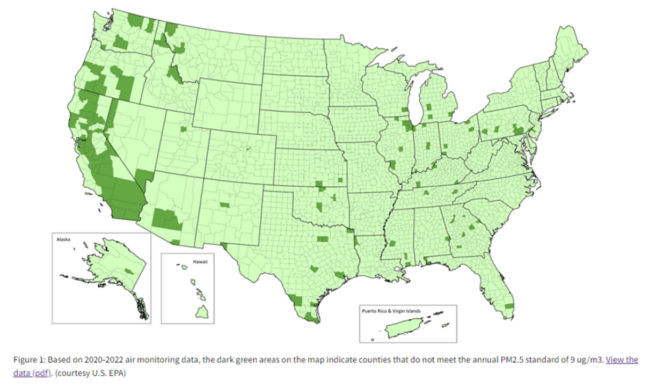
In Louisiana, Caddo Parish and West Baton Rouge Parish, with design values of 9.6 µg/m3 and 9.1 µg/m3, respectively, would not meet the PM2.5 NAAQS of 9 µg/m3. However, Louisiana’s Department of Environmental Quality has submitted two “exceptional event”1 demonstrations to the EPA for consideration, both dealing with the Port Allen monitoring station in West Baton Rouge Parish. The events included a Saharan Dust that resulted in 5 days of elevated PM2.5 levels in June 2022 and a Canadian Wildfire Smoke that resulted in 2 days of PM2.5 exceedances in October 2023. Removal of these “exceptional events” would result in West Baton Rouge Parish meeting the PM2.5 NAAQS of 9 µg/m3.
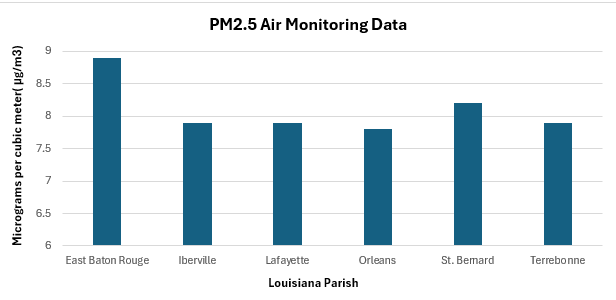
In addition to the areas that would likely be in non-attainment, there are also numerous areas that would be very close to exceeding the standard, which would severely limit growth and development in those areas. In Louisiana specifically, the following parishes have design values that are approaching the 9 µg/m3 standard:
Litigation Challenging Final Rule Tightening PM2.5 NAAQS
OnMarch 6, 2024, a group of states, including Louisiana, and other industry groups filed petitions for judicial review in the D.C. Circuit, requesting the court to vacate EPA’s rule tightening the PM2.5 NAAQS. See Commonwealth of Kentucky et al. v. EPA et al., No. 24-1050 (D.C. Cir. Mar. 6, 2024). The industry groups and states claimed that EPA acted in a manner contrary to law by improperly undertaking a discretionary, non-statutory reconsideration of the PM2.5 NAAQS, rather than a statutorily-mandated review under CAA § 109(d) (i.e., five-year review), and failing to adequately consider all required and relevant factors, including costs, in making its decision. Oral argument was held on December 16, 2024. Most recently, on February 25, 2025, the D.C. Circuit granted EPA’s motion to hold the case in abeyance for 60 days to allow new EPA leadership to review the PM2.5 NAAQS.
Reconsideration of PM2.5 NAAQS
In connection with the agency’s March 12, 2025, announcement to reconsider the PM2.5 NAAQS, EPA Administrator Zeldin noted that the previous administration’s PM2.5 NAAQS raised serious concerns from states and served as a major obstacle to permitting. “Under President Trump, we will ensure air quality standards for particulate matter are protective of human health and the environment while we unleash the Golden Age of American prosperity,” said Zeldin. It is important to note that any attempt by EPA to revise the previous administration’s PM2.5 NAAQS will be subject to the formal rulemaking process, including notice and comment periods.
In addition to a reconsideration of the PM2.5 NAAQS, EPA announced that “it will soon release guidance to increase flexibility on NAAQS implementation, reforms to New Source Review, and direction on permitting obligations.”
Stay tuned for further developments. Liskow will be monitoring and covering further actions regarding the new administration’s reconsideration of the PM2.5 NAAQS on Liskow’s The Louisiana Industrial Insights Hub. For more information on industry impacts and opportunities arising under the new administration, please contact Liskow attorneys Greg Johnson, Clare Bienvenu, and Colin North.
1One of EPA’s 31 historic deregulatory actions includes a reconsideration of its Exceptional Events Rule.
]]>
On Tuesday, the Louisiana Supreme Court rejected an attempt to block a constitutional amendment needed to complete the restructuring of the state’s tax laws sought by Gov. Jeff Landry and the Louisiana Legislature. The Court allowed to move forward a statewide vote on a package of changes to the state’s tax laws by dismissing a... Continue Reading]]>
On Tuesday, the Louisiana Supreme Court rejected an attempt to block a constitutional amendment needed to complete the restructuring of the state’s tax laws sought by Gov. Jeff Landry and the Louisiana Legislature. The Court allowed to move forward a statewide vote on a package of changes to the state’s tax laws by dismissing a case challenging how the reforms were presented to voters.
Among other substantive changes, the amendment would remove the cap that limits how much in severance tax revenue local governments can receive from the state for oil, gas and other mineral activity on their lands. The amendment also would require a portion of the money generated from the severance tax on certain types of brine to be paid to parishes.
While folks at the Capitol are focused on the March 29th ballot, Louisiana taxpayers should expect the Legislature to revisit some of the measures that were enacted during last year’s special session in the upcoming fiscal session which starts in April.
Lawmakers are expected to make an attempt to lower severance taxes on oil. Currently, the state’s horizontal well exemption spares much of the natural gas production from taxation; limiting that exemption could allow the Legislature to pay for a lower rate on oil.
Read the full post on Liskow’s Gulf Coast Business Law Blog here.
]]> On March 12, 2025, EPA Administrator Zeldin announced that the agency will undertake 31 deregulatory actions to advance President Trump’s Day One executive orders and EPA’s “Powering the Great American Comeback.” Continue Reading]]>
On March 12, 2025, EPA Administrator Zeldin announced that the agency will undertake 31 deregulatory actions to advance President Trump’s Day One executive orders and EPA’s “Powering the Great American Comeback.” Below is a list of the actions with hyperlinks that include background information and additional detail on the specific action:
UNLEASHING AMERICAN ENERGY
- Reconsideration of regulations on power plants (Clean Power Plan 2.0)
- Reconsideration of air regulations throttling the oil and gas industry (OOOO b/c)
- Reconsideration of Mercury and Air Toxics Standards that improperly targeted coal-fired power plants (MATS)
- Reconsideration of mandatory Greenhouse Gas Reporting Program that imposed significant costs on the American energy supply (GHG Reporting Program)
- Reconsideration of water effluent limitations, guidelines and standards (ELG) for the Steam Electric Power Generating Industry to ensure low-cost electricity while protecting water resources (Steam Electric ELG)
- Reconsideration of wastewater regulations for oil and gas development to help unleash American energy (Oil and Gas ELG)
- Reconsideration of Biden-Harris Administration Risk Management Program rule that made America’s oil and natural gas refineries and chemical facilities less safe (Risk Management Program Rule)
LOWERING THE COST OF LIVING FOR AMERICAN FAMILIES
- Reconsideration of light-duty, medium-duty, and heavy-duty vehicle regulations that provided the foundation for the Biden-Harris electric vehicle mandate (Car GHG Rules)
- Reconsideration of the 2009 Endangerment Finding and regulations and actions that rely on that Finding (Endangerment Finding)
- Reconsideration of the technology transition rule that forces companies to use certain technologies that increased costs on food at grocery stores and semiconductor manufacturing (Technology Transition Rule)
- Reconsideration of Particulate Matter National Ambient Air Quality Standards that shut down opportunities for American manufacturing and small businesses (PM 2.5 NAAQS)
- Reconsideration of multiple National Emission Standards for Hazardous Air Pollutants for American energy and manufacturing sectors (NESHAPs)
- Restructuring the Regional Haze Program that threatened the supply of affordable energy for American families (Regional Haze)
- Overhauling the Biden-Harris Administration’s “Social Cost of Carbon”
- Redirecting enforcement resources to EPA’s core mission, with the aim of relieving the economy of unnecessary bureaucratic burdens that drive up costs for American consumers (Enforcement Discretion)
- Terminating Biden’s Environmental Justice and DEI arms of EPA (EJ/DEI)
ADVANCING COOPERATIVE FEDERALISM
- Ending so-called “Good Neighbor Plan” which the Biden-Harris Administration used to expand federal rules to more states and sectors beyond the program’s traditional focus and led to the rejection of nearly all State Implementation Plans
- Working with states and tribes to resolve massive backlog with State Implementation Plans and Tribal Implementation Plans that the Biden-Harris Administration refused to resolve (SIPs/TIPs)
- Reconsideration of exceptional events rulemaking to work with states to prioritize the allowance of prescribed fires within State and Tribal Implementation Plans (Exceptional Events)
- Reconstituting the Science Advisory Board and the Clean Air Scientific Advisory Committee (SAB/CASAC)
- Prioritizing the coal ash program to expedite state permit reviews and update coal ash regulations (CCR Rule)
- Utilizing enforcement discretion to further North Carolina’s recovery from Hurricane Helene
Many of these actions target promulgated regulations, so any effort to revise them will be subject to the formal rulemaking process, including notice and comment periods, and will likely face legal challenges. Industry should remain alert for developments associated with these actions. Liskow will be monitoring and covering further actions regarding the new administration’s deregulatory push on Liskow’s The Louisiana Industrial Insights Hub. For more information on industry impacts and opportunities arising under the new administration, please contact Liskow attorneys Greg Johnson, Clare Bienvenu, and Colin North.
]]> On March 12, 2025, EPA and the Army Corps of Engineers issued a joint memorandum providing guidance to field staff on implementing the definition of “waters of the United States” (WOTUS) as it pertains to “adjacent wetlands.” Continue Reading]]>
On March 12, 2025, EPA and the Army Corps of Engineers issued a joint memorandum providing guidance to field staff on implementing the definition of “waters of the United States” (WOTUS) as it pertains to “adjacent wetlands.”1 The memorandum represents a new iteration of the decades-old debate on the extent of Clean Water Act (CWA) authority over wetlands adjacent to jurisdictional navigable WOTUS. The previous iteration took place under the Biden Administration after the Supreme Court announced a two-part test in Sackett v. EPA. There, the Supreme Court held that CWA authority over WOTUS extends only to wetlands when: (1) the adjacent body of water is a “relatively permanent body of water connected to traditional interstate navigable waters” and (2) the wetland has “a continuous surface connection with that water, making it difficult to determine where the water ends and the wetland begins.” The new guidance narrows the scope of WOTUS by clarifying the current administration’s interpretation of when a wetland has a “continuous surface connection.”
The new guidance states that CWA authority will not extend to wetlands that are connected to jurisdictional waters by discrete features like non-jurisdictional ditches, swales, pipes, or culverts. It also explicitly rescinds any components of guidance or training materials that assumed a non-jurisdictional discrete feature established a continuous surface connection, citing materials compiled under the Biden Administration. The new guidance from the Trump Administration takes issue with such prior implementation, finding the “discrete features” language in tension with the “continuous surface connection” standard that Sackett set forth. EPA and the Army Corps now state that WOTUS includes “only those adjacent wetlands that have a continuous surface connection because they directly abut the [requisite jurisdictional water] (e.g., they are not separated by uplands, a berm, dike, or similar feature).”
In addition to the new guidance, EPA and the Army Corps issued a notice in the Federal Register regarding their intent to engage with stakeholders and gather recommendations on the meaning of key terms from Sackett, such as “relatively permanent” and “continuous surface connection,” to inform any potential future administrative actions to clarify the WOTUS definition and to ensure transparent, efficient, and predictable implementation.2 Stakeholders have challenged Biden-era implementation of CWA authority over adjacent wetlands in ongoing litigation, and the listening sessions are aimed at ensuring any potential, future action “will reflect consideration of the experiences of, and input received from, landowners, industry groups, the agricultural community, States, Tribes, local governments, community organizations, environmental groups, and the general public.”
The agencies will hold at least six listening sessions, with two open to all stakeholders, one open to States, one open to Tribes, one open to industry and agricultural stakeholders, and one open to environmental and conservational stakeholders. The listening sessions will be held as web and in-person conferences in late March-April 2025. Registration instructions and dates will be forthcoming at the following website here.
The listening sessions may lead to a more robust form of administrative action, such as a rulemaking to amend the existing regulations defining WOTUS, which would be more difficult for a future administration to reverse.
Liskow will be monitoring and covering further actions regarding the WOTUS definition under the new administration on Liskow’s The Louisiana Industrial Insights Hub. For more information on industry impacts and opportunities arising under the new administration, please contact Liskow attorneys Greg Johnson, Clare Bienvenu, and Colin North.
]]>
 On February 6, 2025, the Trump Administration announced the appointment of Scott Mason IV as regional EPA Administrator for Region 6. Headquartered in Dallas, Texas, Region 6 covers Arkansas, Louisiana, New Mexico, Oklahoma, Texas, and 66 Tribal Nations Continue Reading]]>
On February 6, 2025, the Trump Administration announced the appointment of Scott Mason IV as regional EPA Administrator for Region 6. Headquartered in Dallas, Texas, Region 6 covers Arkansas, Louisiana, New Mexico, Oklahoma, Texas, and 66 Tribal Nations.
Mason is a citizen of the Cherokee Nation and a 5th generation Oklahoman who earned his bachelor’s and master’s degrees from the University of Oklahoma. Mason previously served as the Director of EPA’s American Indian Environmental Office during President Trump’s first administration. He was also a member of the White House Council on Native American Affairs, where he served as co-chair of the Council’s Committee on Infrastructure. Mason was most recently the Deputy Secretary of Energy of Oklahoma. He has served at the local, state, and federal levels of government in various capacities, including as a vice president and the executive director of federal programs at the University of Oklahoma and on the staff of the Oklahoma Governor.
In a press release announcing the appointment, EPA Administrator Zeldin said, “[Mason] brings with him over twenty years of government experience at all levels, as well as having served as EPA’s director of the American Indian Environmental Office. He is the right person we need leading Region 6. [Mason] has the knowledge, talent, and dedication needed to succeed, and I am ready to get to work with him.”
Mason responded, “I’m grateful for the opportunity to serve the people of [Region 6] who are looking to EPA to fulfill our mission to protect human health and the environment while fostering economic growth. As someone with deep roots in this region, I am committed to working hard each and every day to make a difference in the lives of the people we serve by implementing the President’s agenda and the Administrator’s ‘Powering the Great American Comeback’ Initiative.”
Administrator Zeldin’s “Powering the Great American Comeback” Initiative outlines the EPA’s priorities under his and President Trump’s leadership. The Initiative will guide EPA’s work over the first 100 days and beyond, and it consists of five pillars:
- Pillar 1: Clean Air, Land, and Water for Every American
- Pillar 2: Restore American Energy Dominance
- Pillar 3: Permitting Reform, Cooperative Federalism, and Cross-Agency Partnership
- Pillar 4: Make the United States the Artificial Intelligence Capital of the World
- Pillar 5: Protecting and Bringing Back American Auto Jobs
Liskow will be monitoring and covering EPA actions under the new administration on Liskow’s The Louisiana Industrial Insights Hub. For more information on industry impacts and opportunities arising under the new administration, please contact Liskow attorneys Greg Johnson, Clare Bienvenu, and Colin North.
Disclaimer: This Blog/Web Site is made available by the law firm of Liskow & Lewis, APLC (“Liskow & Lewis”) and the individual Liskow & Lewis lawyers posting to this site for educational purposes and to give you general information and a general understanding of the law only, not to provide specific legal advice as to an identified problem or issue. By using this blog site you understand and acknowledge that there is no attorney-client relationship formed between you and Liskow & Lewis and/or the individual Liskow & Lewis lawyers posting to this site by virtue of your using this site. The Blog/Web Site should not be used as a substitute for legal advice from a licensed professional attorney in your state regarding a particular matter.
Privacy Policy: By subscribing to Liskow & Lewisʼ E-Communications, you will receive articles and blogs with insight and analysis of legal issues that may impact your industry. Communications include firm news, insights, and events. To receive information from Liskow & Lewis, your information will be kept in a secured contact database. If at any time you would like to unsubscribe, please use the SafeUnsubscribe® link located at the bottom of every email that you receive.
]]> On January 20, 2025, President Trump issued the “Unleashing American Energy” Executive Order (“EO”) with the stated purpose of ensuring an abundant supply of affordable and reliable energy in the United States. Continue Reading]]>
On January 20, 2025, President Trump issued the “Unleashing American Energy” Executive Order (“EO”) with the stated purpose of ensuring an abundant supply of affordable and reliable energy in the United States. The EO orders several agency actions aimed at eliminating undue burden on domestic energy development, including specific actions related to the implementation of the National Environmental Protection Act (“NEPA”). NEPA is the statute under which federal agencies are required to assess the environmental impact of their actions, which in turn requires environmental assessments for most federal permits. NEPA established the Council on Environmental Quality (“CEQ”) within the executive office and charged the Council with overseeing NEPA implementation.
With respect to NEPA, the “Unleashing American Energy” EO first revokes President Carter’s Executive Order 11991 of May 24, 1977, Relating to Protection and Enhancement of Environmental Quality, which directed CEQ to issue regulations for the implementation of NEPA. Thereafter, the “Unleashing American Energy” EO directs CEQ to propose rescinding its existing NEPA regulations and provide “guidance” on implementing NEPA by February 19, 2025.
The CEQ NEPA regulations have been in a state of flux, undergoing revisions in Trump’s first term and subsequent revisions under the Biden Administration. The current CEQ regulations promulgated under the Biden Administration have come under recent fire, both with a coalition of states challenging the substance of the amendments in State of Iowa v. CEQ and with the issuance of the D.C. Circuit panel decision in Marin Audubon Society v. FAA, which stated as dicta that CEQ had exceeded its statutory authority under NEPA by promulgating binding NEPA regulations. President Trump’s revocation of President Carter’s 1977 Executive Order and directive to rescind existing CEQ NEPA regulations appears to be grounded in the rationale of the Marin opinion. On January 31, 2025, the D.C. Circuit denied an en banc rehearing of the Marin Audubon Society v. FAA opinion, finding the rehearing unnecessary because the panel had unanimously resolved the case on other grounds.1
Moreover, on February 3, 2025, the North Dakota federal district court issued an opinion in State of Iowa v. CEQ that the regulations were invalid and vacated as a matter of law based on the reasoning included in the Marin opinion. This opinion is likely to be appealed, and other federal courts may come to a different conclusion. This posture potentially creates a patchwork of states in which CEQ regulations are considered valid or invalid, until the regulations are rescinded by CEQ through the formal rulemaking process.
If the CEQ regulations are invalidated or rescinded, any existing agency-specific NEPA regulations will govern NEPA implementation in that agency’s permitting process. To that end, the Trump EO directs CEQ to form a “working group to coordinate the revision of agency-level implementing regulations for consistency” with the CEQ guidance. The EO specifies that the guidance and any resulting regulations “must expedite permitting approvals and meet [statutory] deadlines” and that “agencies must prioritize efficiency and certainty over any other objectives, including those of activist groups, that do not align with the [EO’s] policy goals.”
The EO’s proposed major changes to CEQ’s function and regulations will likely face court challenges, and there will likely be a period of uncertainty and inconsistency regarding what is required under NEPA. In preparing permit applications, industry should both monitor federal agency requirements and assess any further protections that may be needed to safeguard the permit from possible court challenges by project opponents.
For assistance in environmental permitting matters, please contact Liskow attorneys Greg Johnson, Clare Bienvenu, and Emily von Qualen and visit Liskow’s The Louisiana Industrial Insights Hub to follow along for more industry updates.
Disclaimer: This Blog/Web Site is made available by the law firm of Liskow & Lewis, APLC (“Liskow & Lewis”) and the individual Liskow & Lewis lawyers posting to this site for educational purposes and to give you general information and a general understanding of the law only, not to provide specific legal advice as to an identified problem or issue. By using this blog site you understand and acknowledge that there is no attorney-client relationship formed between you and Liskow & Lewis and/or the individual Liskow & Lewis lawyers posting to this site by virtue of your using this site. The Blog/Web Site should not be used as a substitute for legal advice from a licensed professional attorney in your state regarding a particular matter.
Privacy Policy: By subscribing to Liskow & Lewisʼ E-Communications, you will receive articles and blogs with insight and analysis of legal issues that may impact your industry. Communications include firm news, insights, and events. To receive information from Liskow & Lewis, your information will be kept in a secured contact database. If at any time you would like to unsubscribe, please use the SafeUnsubscribe® link located at the bottom of every email that you receive.
1Marin Audubon Society et al. v. Federal Aviation Administration et al., No. 23-1067, petition for en banc rehearing denied (D.C. Cir. Jan. 31, 2025).
]]> On January 29, 2025, the Senate voted to confirm former New York Rep. Lee Zeldin as EPA Administrator. Zeldin is a 44-year-old attorney who represented New York’s 1st Congressional District from 2015-2023. Continue Reading]]>
On January 29, 2025, the Senate voted to confirm former New York Rep. Lee Zeldin as EPA Administrator. Zeldin is a 44-year-old attorney who represented New York’s 1st Congressional District from 2015-2023. During his congressional tenure, Zeldin was known for his experience in international affairs, and his nomination for EPA Administrator was unexpected due to his limited experience with environmental policy issues.
In November 2024, then President-elect Donald Trump announced his selection of Lee Zeldin to serve as EPA Administrator, stating that he “will ensure fair and swift deregulatory decisions that will be enacted in a way to unleash the power of American businesses, while at the same time maintaining the highest environmental standards, including the cleanest air and water on the planet.” Following his selection, Zeldin stated in a post on social media: “It is an honor to join President Trump’s Cabinet as EPA Administrator. We will restore U.S. energy dominance, revitalize our auto industry to bring back American jobs, and make the U.S. the global leader of AI. We will do so while protecting access to clean air and water.”
Both President Trump’s and Zeldin’s comments shed light on the Administration’s vision for the EPA over the next four years, which includes the pursuit of a deregulatory agenda and the potential scaling back of environmental policies and regulations from the Biden administration. Notable points from the nomination hearing include Zeldin’s indication that he would not be eliminating EPA’s enforcement office and that he will be honoring the U.S. Supreme Court’s recent Loper Bright decision in ensuring that EPA actions comport with congressional intent. Other major energy and environmental issues that the agency seeks to tackle under Zeldin’s leadership include permitting reform aimed at increasing domestic energy production and reassessment of EPA’s currently existing finding that greenhouses gases endanger public health.
Liskow will be monitoring and covering EPA actions under the new administration on Liskow’s The Louisiana Industrial Insights Hub. For more information on industry impacts and opportunities arising under the new administration, please contact Liskow attorneys Greg Johnson, Clare Bienvenu, and Colin North.
Disclaimer: This Blog/Web Site is made available by the law firm of Liskow & Lewis, APLC (“Liskow & Lewis”) and the individual Liskow & Lewis lawyers posting to this site for educational purposes and to give you general information and a general understanding of the law only, not to provide specific legal advice as to an identified problem or issue. By using this blog site you understand and acknowledge that there is no attorney-client relationship formed between you and Liskow & Lewis and/or the individual Liskow & Lewis lawyers posting to this site by virtue of your using this site. The Blog/Web Site should not be used as a substitute for legal advice from a licensed professional attorney in your state regarding a particular matter.
Privacy Policy: By subscribing to Liskow & Lewisʼ E-Communications, you will receive articles and blogs with insight and analysis of legal issues that may impact your industry. Communications include firm news, insights, and events. To receive information from Liskow & Lewis, your information will be kept in a secured contact database. If at any time you would like to unsubscribe, please use the SafeUnsubscribe® link located at the bottom of every email that you receive.
]]> On December 10, 2024, President-elect Donald Trump promised expedited permitting for energy and other construction projects worth more than $1 billion. Continue Reading]]>
On December 10, 2024, President-elect Donald Trump promised expedited permitting for energy and other construction projects worth more than $1 billion. While there have been no details of how this would practically look, it reflects the incoming administration’s focus on promoting industrial growth. This may make permitting on the federal level a quicker and easier process for industrial projects.
This is especially so in Louisiana, where the current state administration is also trying to attract and retain energy and industrial projects. For example, the Louisiana Department of Environmental Quality has suggested providing an even faster permit review process (dubbed “Super Duper Fast” permitting) for projects supported by Louisiana Economic Development. This could lead to quicker government engagement and support for such projects at both the state and federal levels.
Moreover, administration changes are likely to be magnified by court decisions in the coming year. While environmental assessments are required under the National Environmental Policy Act (“NEPA”), the exact limits and process for doing so may be changed by upcoming court decisions. The United State Supreme Court is poised to better define the boundaries of what must be considered in a NEPA assessment, and the DC Circuit Court of Appeals has suggested that the overarching NEPA regulations, promulgated by the Council on Environmental Quality, cannot be binding on how other federal agencies implement NEPA.
Much remains to be seen regarding how this will play out on the ground level, and we will be carefully monitoring policy and regulatory developments. While these reforms could result in a swifter permitting process, what will not change are the standards for judicial review of these permitting decisions. Proposed projects will still need to satisfy the legal requirements for industrial permitting, perhaps especially if the state and federal agencies fast track such decisions. Permittees must prioritize having complete and defensible decision records for any issued permits because the change in priorities at the federal level is expected to increase permit challenges from non-government organizations and judicial scrutiny of those decisions remains rigorous.
For assistance in project development and permitting, please contact Lou Buatt, Greg Johnson, Clare Bienvenu and Emily von Qualen and follow along Liskow’s The Louisiana Industrial Insights Hub for regular updates in the industrial project development landscape in Louisiana.
Disclaimer: This Blog/Web Site is made available by the law firm of Liskow & Lewis, APLC (“Liskow & Lewis”) and the individual Liskow & Lewis lawyers posting to this site for educational purposes and to give you general information and a general understanding of the law only, not to provide specific legal advice as to an identified problem or issue. By using this blog site you understand and acknowledge that there is no attorney-client relationship formed between you and Liskow & Lewis and/or the individual Liskow & Lewis lawyers posting to this site by virtue of your using this site. The Blog/Web Site should not be used as a substitute for legal advice from a licensed professional attorney in your state regarding a particular matter.
Privacy Policy: By subscribing to Liskow & Lewisʼ E-Communications, you will receive articles and blogs with insight and analysis of legal issues that may impact your industry. Communications include firm news, insights, and events. To receive information from Liskow & Lewis, your information will be kept in a secured contact database. If at any time you would like to unsubscribe, please use the SafeUnsubscribe® link located at the bottom of every email that you receive.
]]> At the conclusion of the 3rd Extraordinary Session of 2024, the Louisiana Legislature passed a series of bills aimed at reforming the Louisiana tax code. The bills were signed into law by Governor Jeff Landry and a constitutional amendment will be on the ballot on March 29, 2025. Some of the highlights include eliminating the... Continue Reading]]>
At the conclusion of the 3rd Extraordinary Session of 2024, the Louisiana Legislature passed a series of bills aimed at reforming the Louisiana tax code. The bills were signed into law by Governor Jeff Landry and a constitutional amendment will be on the ballot on March 29, 2025. Some of the highlights include eliminating the corporate franchise tax, replacing the marginal individual income tax rate with a flat 3% rate and a higher standard deduction, replacing the marginal corporate income tax rate with a flat 5.5% rate and a $20,000 standard deduction per corporate taxpayer, and increasing the state sales tax rate to 5%, to be reduced to 4.75% on January 1, 2030. All of these changes will be effective January 1, 2025.
Read the full post on The Gulf Coast Business Law Blog here.
Disclaimer: This Blog/Web Site is made available by the law firm of Liskow & Lewis, APLC (“Liskow & Lewis”) and the individual Liskow & Lewis lawyers posting to this site for educational purposes and to give you general information and a general understanding of the law only, not to provide specific legal advice as to an identified problem or issue. By using this blog site you understand and acknowledge that there is no attorney-client relationship formed between you and Liskow & Lewis and/or the individual Liskow & Lewis lawyers posting to this site by virtue of your using this site. The Blog/Web Site should not be used as a substitute for legal advice from a licensed professional attorney in your state regarding a particular matter.
Privacy Policy: By subscribing to Liskow & Lewisʼ E-Communications, you will receive articles and blogs with insight and analysis of legal issues that may impact your industry. Communications include firm news, insights, and events. To receive information from Liskow & Lewis, your information will be kept in a secured contact database. If at any time you would like to unsubscribe, please use the SafeUnsubscribe® link located at the bottom of every email that you receive.
]]> As we approach the year-end, taxpayers should consider the following amendments to regulations made by the Louisiana Department of Revenue earlier this year that go into effect today and on January 1st and the emergency rule regarding the following real and personal property regulations: LAC 61:V.703, 705, 901, 903, 907, 1007, 1103, 1301, 1303, 1307, 1503,... Continue Reading]]>
As we approach the year-end, taxpayers should consider the following amendments to regulations made by the Louisiana Department of Revenue earlier this year that go into effect today and on January 1st and the emergency rule regarding the following real and personal property regulations: LAC 61:V.703, 705, 901, 903, 907, 1007, 1103, 1301, 1303, 1307, 1503, 2501, 2503 and 3103 also effective on January 1st.
Read the full post on the Gulf Coast Business Law Blog here.
Disclaimer: This Blog/Web Site is made available by the law firm of Liskow & Lewis, APLC (“Liskow & Lewis”) and the individual Liskow & Lewis lawyers posting to this site for educational purposes and to give you general information and a general understanding of the law only, not to provide specific legal advice as to an identified problem or issue. By using this blog site you understand and acknowledge that there is no attorney-client relationship formed between you and Liskow & Lewis and/or the individual Liskow & Lewis lawyers posting to this site by virtue of your using this site. The Blog/Web Site should not be used as a substitute for legal advice from a licensed professional attorney in your state regarding a particular matter.
Privacy Policy: By subscribing to Liskow & Lewisʼ E-Communications, you will receive articles and blogs with insight and analysis of legal issues that may impact your industry. Communications include firm news, insights, and events. To receive information from Liskow & Lewis, your information will be kept in a secured contact database. If at any time you would like to unsubscribe, please use the SafeUnsubscribe® link located at the bottom of every email that you receive.
]]>
Owners of businesses in Louisiana considering a sale or divestiture of their ownership interests or substantially all of the assets of a business entity domiciled in this state should be advised that during the 2024 Third Extraordinary Session the legislature repealed the net capital gains deduction in its entirety. Read the full post on the... Continue Reading]]>
Owners of businesses in Louisiana considering a sale or divestiture of their ownership interests or substantially all of the assets of a business entity domiciled in this state should be advised that during the 2024 Third Extraordinary Session the legislature repealed the net capital gains deduction in its entirety.
Read the full post on the Gulf Coast Business Law Blog here.
Disclaimer: This Blog/Web Site is made available by the law firm of Liskow & Lewis, APLC (“Liskow & Lewis”) and the individual Liskow & Lewis lawyers posting to this site for educational purposes and to give you general information and a general understanding of the law only, not to provide specific legal advice as to an identified problem or issue. By using this blog site you understand and acknowledge that there is no attorney-client relationship formed between you and Liskow & Lewis and/or the individual Liskow & Lewis lawyers posting to this site by virtue of your using this site. The Blog/Web Site should not be used as a substitute for legal advice from a licensed professional attorney in your state regarding a particular matter.
Privacy Policy: By subscribing to Liskow & Lewisʼ E-Communications, you will receive articles and blogs with insight and analysis of legal issues that may impact your industry. Communications include firm news, insights, and events. To receive information from Liskow & Lewis, your information will be kept in a secured contact database. If at any time you would like to unsubscribe, please use the SafeUnsubscribe® link located at the bottom of every email that you receive.
]]> The National Labor Relations Board (“NLRB”) has been busy recently, reversing 80-year-old precedent concerning captive audience meetings and 40-year-old precedent concerning permissible statements about the impacts of unionization. Read the full post on the Gulf Coast Business Law Blog here. Disclaimer: This Blog/Web Site is made available by the law firm of Liskow & Lewis,... Continue Reading]]>
The National Labor Relations Board (“NLRB”) has been busy recently, reversing 80-year-old precedent concerning captive audience meetings and 40-year-old precedent concerning permissible statements about the impacts of unionization.
Read the full post on the Gulf Coast Business Law Blog here.
Disclaimer: This Blog/Web Site is made available by the law firm of Liskow & Lewis, APLC (“Liskow & Lewis”) and the individual Liskow & Lewis lawyers posting to this site for educational purposes and to give you general information and a general understanding of the law only, not to provide specific legal advice as to an identified problem or issue. By using this blog site you understand and acknowledge that there is no attorney-client relationship formed between you and Liskow & Lewis and/or the individual Liskow & Lewis lawyers posting to this site by virtue of your using this site. The Blog/Web Site should not be used as a substitute for legal advice from a licensed professional attorney in your state regarding a particular matter.
Privacy Policy: By subscribing to Liskow & Lewisʼ E-Communications, you will receive articles and blogs with insight and analysis of legal issues that may impact your industry. Communications include firm news, insights, and events. To receive information from Liskow & Lewis, your information will be kept in a secured contact database. If at any time you would like to unsubscribe, please use the SafeUnsubscribe® link located at the bottom of every email that you receive.
]]> The Offshore Parity Act of 2024 (H.R. 10183), introduced on November 20, 2024, by Congressmen Garret Graves (R-LA) and Troy A. Carter, Sr. (D-LA), looks to extend Louisiana’s state authority from 3 to 9 nautical miles offshore into the Gulf of Mexico. Continue Reading]]>
The Offshore Parity Act of 2024 (H.R. 10183), introduced on November 20, 2024, by Congressmen Garret Graves (R-LA) and Troy A. Carter, Sr. (D-LA), looks to extend Louisiana’s state authority from 3 to 9 nautical miles offshore into the Gulf of Mexico. The bipartisan legislation would amend the Outer Continental Shelf Lands Act (OCSLA) and the Magnuson-Stevens Fishery Conservation and Management Act, giving Louisiana, Mississippi, and Alabama (“State” or “States”)1 the same offshore authority and sovereignty currently enjoyed by Texas and Florida.
The evolution of state jurisdiction over its coastal waters dates back to the “cannon shot rule” in the 1800s, which initially established the 3-mile offshore boundary.2 In the early 20th century, and with the increased development of offshore industries, Congress adopted the Submerged Lands Act (SLA) of 1953. The SLA granted Texas and the Gulf Coast of Florida jurisdiction of 9 nautical miles off their coastlines while establishing Louisiana, Mississippi, and Alabama’s coastline at three nautical miles. Louisiana unsuccessfully challenged this restriction before the United States Supreme Court in 1969 where the Court held that Louisiana could not prove it had jurisdiction over the waters extending 3 marine leagues from its coastline before it entered the Union. As such, its state waters boundary would remain at 3 nautical miles.3
The proposed legislation would generally give Louisiana, Mississippi, and Alabama the authority to manage oil, gas, and other energy activities located on the state’s expanded submerged land.4 Pertinent provisions of H.R. 10183 include:
- Delegation of authority to the States to grant and manage leases wholly located within the State’s expanded submerged land;5
- The delegation of authority shall apply to any lease of the State’s expanded submerged land, which is granted by the Secretary before the date of enactment of the Offshore Parity Act of 2024
- With respect to lease revenue,
- States may collect rentals, royalties, and other sums, as determined by the State, from any lease granted by the State after the enactment date of the proposed legislation6;
- However, the States’ authority shall not affect the disposition of revenue under any other provision of federal law from any lease of the State’s expanded submerged land granted before the enactment date of the proposed legislation;7
Currently, under the Gulf of Mexico Energy Security Act (GOMESA) of 2006, a portion of the revenues from offshore oil and gas production in the Gulf of Mexico is shared with four states: Texas, Louisiana, Mississippi, and Alabama. As seen above, the proposed legislation’s expansion of state waters and related provisions would likely lead to potential modifications or negotiations over how revenue from these areas is distributed, as well as increases in state revenue and new sources of revenue not previously accessible before the proposed expansion.
The bill has been referred to the House Committee on Natural Resources for review and debate. If it passes favorably out of the House Committee, it is then debated by all members of the House. If a majority of the House votes in favor of the bill, it is sent to the Senate where it follows a similar process.8 Once both the House and Senate agree on the final version of the bill, it will be sent to the President who can either sign the bill into law or veto the bill and send it back to Congress. For further questions regarding the proposed Offshore Parity Act of 2024, contact Liskow attorneys Cristian Soler and Jana Grauberger and visit our Federal Offshore Regulatory practice page.
1H.R. 10183, Section 34(a)(4).
2The idea was that a coastal nation’s jurisdiction should be measured by the distance in which it could defend itself. This “self-defense” limit was measured by how far a cannon shot could be fired, which at the time was approximately a marine league, or 3 nautical miles.
3United States vs. Louisiana, 394 U.S. 11 (1969).
4The term “expanded submerged land” means the area of the outer Continental Shelf that is located between 3 geographical miles and 3 marine leagues seaward of the coast line of the State as of the day before the date of the enactment of this section. H.R. 10183 Section 34(a)(2).
5H.R. 10183, Section 34(b) provides in full:
(b) Delegation.—Upon written request of a State before the date that is 5 years after the date of enactment of the Offshore Parity Act of 2024, the Secretary shall, except as provided in subsection (c), delegate to the State the relevant authorities of the Secretary under this Act, except the authority under sections 14 and 20, to grant and manage leases of the expanded submerged land of the State if the Secretary finds that—
(1) it is likely the State will provide adequate resources to carry out such authorities;
(2) the State has demonstrated that it will effectively and faithfully administer the applicable rules and regulations of the Secretary under this Act, including the requirements of subsection (c) of this section; and
(3) such delegation will not create an unreasonable burden on any lessee.
6H.R. 10183, Section 34(c)(4).
7H.R. 10183, Section 34(c)(4)(C)(i).
8There are additional steps in the process if the House and/or Senate propose amendments to the bill or if the House and Senate pass different versions of the bill.
Disclaimer: This Blog/Web Site is made available by the law firm of Liskow & Lewis, APLC (“Liskow & Lewis”) and the individual Liskow & Lewis lawyers posting to this site for educational purposes and to give you general information and a general understanding of the law only, not to provide specific legal advice as to an identified problem or issue. By using this blog site you understand and acknowledge that there is no attorney-client relationship formed between you and Liskow & Lewis and/or the individual Liskow & Lewis lawyers posting to this site by virtue of your using this site. The Blog/Web Site should not be used as a substitute for legal advice from a licensed professional attorney in your state regarding a particular matter.
Privacy Policy: By subscribing to Liskow & Lewisʼ E-Communications, you will receive articles and blogs with insight and analysis of legal issues that may impact your industry. Communications include firm news, insights, and events. To receive information from Liskow & Lewis, your information will be kept in a secured contact database. If at any time you would like to unsubscribe, please use the SafeUnsubscribe® link located at the bottom of every email that you receive.
]]> In 2021, the Biden Administration set a goal of deploying 30 gigawatts (“GW”) of federal offshore wind projects by 2030, and in 2022, the U.S. Department of the Interior (“DOI”) set an additional goal of deploying 15 GW of floating offshore wind by 2035. Continue Reading]]>
In 2021, the Biden Administration set a goal of deploying 30 gigawatts (“GW”) of federal offshore wind projects by 2030, and in 2022, the U.S. Department of the Interior (“DOI”) set an additional goal of deploying 15 GW of floating offshore wind by 2035. The DOI’s Bureau of Ocean Energy Management (“BOEM”), which administers the federal government’s offshore oil and gas and renewable energy leasing programs, has now approved half of the capacity needed to achieve the 30 GW by 2030 goal, after issuing the National Environmental Policy Act (“NEPA”) Record of Decision (“ROD”) for the Maryland Offshore Wind project in September 2024, making it the nation’s 10th federally approved commercial-scale offshore wind project to date. All 10 are located on the Atlantic outer continental shelf (“OCS”) where the offshore wind industry is the most developed: (1) Vineyard Wind 1; (2) South Fork Wind; (3) Ocean Wind 1; (4) Revolution Wind; (5) Coastal Virginia Offshore Wind; (6) Empire Wind; (7) Sunrise Wind; (8) New England Wind 1 and 2; (9) Atlantic Shores South; and now (10) Maryland Offshore Wind. Maryland Offshore Wind is the only one of those 10 total federally approved projects that has not yet had its Construction and Operations Plan (“COP”) approved by BOEM, which once issued authorizes the commencement of construction activities, sometimes subject to additional requirements imposed by the agency. So far, BOEM has approved five COPs this year (in addition to updating the conditions of COP approval for Revolution Wind), bringing BOEM’s total to nine COP approvals issued to date, advancing towards the agency’s current goal to complete the review of 16 COPs by 2025 to achieve the 30 GW by 2030 goal.
Although federal offshore wind development started to pick up this year, so did opposition to the burgeoning industry, along with inevitable perils that come with developing a new frontier:
A. Permitting offshore wind projects is time-consuming. The time required to complete federal permitting is averaging just under 4 years from start to finish, with the potential to send projects into the red before construction even begins. Of the 10 total projects which have been federally approved to date, seven are “FAST-41 Covered Projects” (Sunrise, New England, Empire, Coastal, Revolution, South Fork, and Vineyard) with exact permitting data available for each of the 12 (maximum) required federal permits, as well as a precise timeframe as to how long the entire federal permitting process took. Based on the FAST-41 data for those seven projects which have fully completed all federal permitting, the total time it took to obtain up to all 12 permits – including all time spent planning and in progress, as well as any pauses, delays, and extensions – averaged around 3 years and 8 months (approximately 44.3 months). Unless otherwise noted below, each of those seven projects required:
1. NEPA Final Environmental Impact Statement (“EIS”) (finalized by issuance of NEPA Joint ROD by DOI’s BOEM and the Department of Commerce (“DOC”), and in some cases the Department of Defense (“DOD”) must also co-sign);
2. COP (generally approved two to five months after NEPA ROD issuance);
3. National Historic Preservation Act § 106 Review;
4. OCS Air Permit (six of the seven completed FAST-41 projects required);
5. National Park Service Permit (only one, Sunrise, required for a Right-of-Way and Special Use Permit for access through National Seashore Waters);
6. Clean Water Act (“CWA”) § 402 and National Pollutant Discharge Elimination System Permit (only one required);
7. CWA § 404 and Rivers and Harbors Act of 1899 § 10 Permits;
8. CWA § 408 Permit (only three required);
9. Endangered Species Act (“ESA”) Consultation with DOI’s U.S. Fish and Wildlife Service;
10. ESA Consultation with the DOC National Oceanic and Atmospheric Administration’s (“NOAA”) National Marine Fisheries Service (“NMFS”);
11. Marine Mammal Protection Act Incidental Take Authorization from NMFS; and
12. Magnuson-Stevens Fishery Conservation and Management Act § 305 Essential Fish Habitat Consultation.
B. It remains an open question whether projects canceled by developers can later be sold without the assignee having to restart the federal permitting process; whether all federal approvals are assignable; and if vacating state orders approving federal offshore wind projects and associated state-issued easements nullifies that project’s federal permits.
1. On October 31, 2023, Ørsted A/S’s (“Ørsted”) Board of Directors decided to cancel both Ocean Wind 1 and Ocean Wind 2 – after all permitting had been completed for Ocean Wind 1 (with BOEM approving the project’s COP in September 2023). Accordingly, on February 29, 2024, BOEM suspended the Ocean Wind 1 lessee’s (Ocean Wind LLC, an Ørsted subsidiary) commercial wind lease for two years. On May 25, 2024, the State of New Jersey and its New Jersey Board of Public Utilities (“NJBPU”) entered a settlement agreement with Ørsted authorizing the distribution of Ørsted’s $200 million in escrow funds amongst the settlement parties and entering mutual limited releases discharging each party from liability for claims concerning or arising out of the project cancellations. On August 14, 2024, the NJBPU formally vacated its two “award orders” approving the Ocean Wind 1 and 2 projects, as well as the four easements it granted Ocean Wind 1 on property owned by Ocean City or the County of Cape May.
2. The Ocean Wind 1 and 2 project cancellations also followed the filing of County of Cape May v. United States, No. 1:23-cv-21201 (D.N.J.), a legal challenge to Ocean Wind 1 that was just dismissed without prejudice on November 20, 2024, after all parties agreed to dismissal (for different reasons) within their briefs based on the project’s cancellation (although plaintiffs originally argued the COP approval and federal permits remained justiciable final agency actions). Notably, plaintiffs also used their reply in support of their motion to amend the complaint as an opportunity to assert that “the federal permits, without the state approvals, are no longer operative and, in the event the Company sold the Project, any new developer would have to begin the permitting and approval process all over again.” Plaintiffs further claim the federal defendants agree with their position, citing to BOEM’s prior statement that “even if and when the federal suspension is lifted – the cancellation of NJBP[U]’s easements and permit precludes construction of the project” and that without easements “Ocean Wind 1 cannot proceed.” On November 7, 2024, intervenor-defendant lessee Ocean Wind LLC filed its sur-reply, therein preserving its positions that: Ocean Wind 1 and all of its approvals and permits can be sold to another entity; all such federal entitlements remain valid and in effect; plaintiffs “mischaracterize the Federal Defendants’ position” as to the effect of the NJBPU’s actions; and the NJBPU cancellation orders and settlement have no bearing on “and do not purport to have any impact” on the federal entitlements obtained for Ocean Wind 1. The U.S. District Court for the District of New Jersey did not address any of these arguments before dismissing the case.
C. As more projects are being approved and constructed, a new concern is whether the developer will be able to secure offtake agreements for electricity sales at all or on economic terms.
1. On January 3, 2024, Equinor Renewables Americans (“Equinor”) and bp America (“bp”) announced cancellation of the offtake agreements previously entered with the New York State Energy Research and Development Authority (“NYSERDA”) for their prior joint ventures Empire Wind 2 (which Equinor now has full ownership of following a stake “swap transaction”) and Beacon Wind (which bp now has full ownership of), after announcing they did not plan to develop the projects unless they could meet return thresholds of 6-8%. The offtake cancellations followed the New York State Public Service Commission’s October 2023 rejection of developers’ petitions for financial relief, unsuccessfully seeking to revise the projects’ Offshore Wind Renewable Energy Certificate (“OREC”) (i.e., a tradable commodity representing the environmental benefits of producing offshore wind energy) Purchase and Sale Agreements (“PSAs”) to reflect current commercial conditions and increased costs from inflation which rendered the existing terms unviable. NYSERDA announced the Joint Termination Agreements terminating the OREC PSAs for Empire Wind 2 on January 5, 2024, and for Beacon Wind on January 25, 2024. However, that offtake cancellation did not prevent BOEM from approving the COP for Empire Wind 1 and 2 on February 2, 2024. Equinor noted that “Empire Wind 2 will be further matured for future solicitation rounds” (i.e., competitive “calls for proposals from offshore wind developers to deliver offshore wind energy to New York State”) such that the project could still potentially enter an OREC PSA with NYSERDA under different terms at some point in the future.
2. In June of 2024, Equinor’s Empire Wind 1 and Ørsted’s Sunrise Wind (now solely owned by Ørsted as of July 2024 following its acquisition of Eversource’s 50% partnership stake) entered OREC PSAs with NYSERDA, each with a strike price of $155 per megawatt-hour (“MWh”) and $146 per MWh, respectively. This followed NYSERDA’s February 2024 announcement that Empire Wind 1 and Sunrise Wind were the provisional winners of New York’s fourth offshore wind solicitation (“NY4”), held in November of 2023.
D. This year has presented a lack of competitive interest in and eligible bidders for federal offshore wind lease sales in less developed OCS regions like the Gulf of Mexico and Oregon, as well as legal challenges to the environmental reviews for those new lease areas.
1. BOEM initially published a Proposed Sale Notice for what would have been the second Gulf of Mexico wind lease sale on March 21, 2024, and originally scheduled that auction for September of 2024. But on July 26, 2024, BOEM canceled that lease sale due to a reported lack of competitive interest after only one bidder was deemed qualified to bid. However, on February 16, 2024, Hecate Energy Gulf Wind LLC (“Hecate Energy”) submitted an unsolicited request for two commercial wind leases in BOEM’s Wind Energy Area Options C and D offshore southeast Texas (the “RFCI Areas”). Simultaneous with its cancellation of the second Gulf of Mexico lease sale, BOEM published a Notice of Potential Commercial Leasing for Wind Power Development on the Gulf of Mexico OCS – Request for Competitive Interest (“RFCI”), seeking comments and input on whether there is competitive interest in commercial offshore wind energy development in the RFCI Areas requested by Hecate Energy. In response, Invenergy Gulf of Mexico Offshore submitted its Indication of Interest in the Gulf of Mexico RFCI Areas on September 11, 2024, “express[ing an] interest in acquiring a commercial wind lease within the RFCI Areas . . . with the intention of demonstrating commercial and competitive interest, and encouraging BOEM to proceed with the competitive leasing process for the RFCI Areas.”
2. Then, on September 27, 2024, BOEM canceled would have been the first-ever Oregon OCS wind auction scheduled for October 2024. Earlier that same morning, Oregon Governor Tina Kotek issued a letter to BOEM requesting the agency “halt all current leasing activities off the coast of Oregon and terminate the current auction” and “withdraw[ing Oregon] from the BOEM Oregon Intergovernmental Renewable Energy Task Force in order to ensure that Oregon’s interests are fully protected, and that there is adequate time to complete [the] state Roadmap with engagement and participation of key constituencies and the public.” The Oregon auction cancellation also followed the filing of Confed. Tribes of Coos, Lower Umpqua & Siuslaw Indians v. BOEM, No. 6:24-cv-01558 (D. Or.), on September 13, 2024, where four bands across three Tribes (federally recognized as a single entity) with ancestral lands along the Oregon coast challenged BOEM’s environmental review for the Oregon OCS auction. On November 19, 2024, defendant BOEM filed an unopposed motion for extension of time to file its answer to plaintiff’s complaint. Therein BOEM notes it “requests the extension because it is not clear whether it will be necessary to litigate this case” since the agency postponed the auction indefinitely and because “additional time [is needed] for the parties to discuss whether the case will go forward[.]” BOEM admits it is not likely that the sale will go forward within the next year, but notes plaintiff has not yet dismissed the case “[g]iven that there is some uncertainty[.]” On November 25, 2024, the U.S. District Court for the District of Oregon granted the request and extended the response deadline to January 17, 2025.
E. More and more lawsuits are being filed by Tribes, local community members and private associations, as well as environmental groups, which add time and increase costs that could result in developers ultimately canceling offshore wind projects. The best example of these lawsuits are the numerous challenges to Vineyard Wind, the first federal offshore wind farm in the U.S. At least two such challenges to Vineyard Wind remain pending in the U.S. Court of Appeals for the First Circuit, and one could be heard next by the U.S. Supreme Court.
1. This year, the First Circuit upheld the U.S. District Court for the District of Massachusetts’ dismissal of two challenges to Vineyard Wind. Melone, et al. v. Coit, et al., No. 23-1736, 100 F.4th 21 (1st Cir. Apr. 25, 2024) (affirming dismissal), aff’g, Allco Renewable Energy Ltd., et al. v. Haaland, et al., No. 21-cv-11171 (D. Mass. June 30, 2022, Aug. 4, 2023); Nantucket Residents Against Turbines, et al. v. U.S. BOEM, et al., No. 23-1501, 100 F.4th 1 (1st Cir. Apr. 24, 2024) (affirming dismissal), aff’g, No. 21-cv-11390 (D. Mass. May 17, 2023), pet. filed (U.S. Sept. 23, 2024). The Nantucket Residents Against Turbines’ petition for writ of certiorari to the U.S. Supreme Court was docketed on September 25, 2024, and remains pending.
2. Last year, the District of Massachusetts dismissed two other challenges to Vineyard Wind; both were appealed to the First Circuit and are awaiting decisions after back-to-back oral arguments were held before the same three-judge panel on July 25, 2024. Responsible Offshore Development Alliance, et al. v. US DOI, et al., No. 22-cv-00237 (D.D.C. June 27, 2022), transferred, No. 22-cv-11172 (D. Mass. Oct. 12, 2023), appeal filed, No. 23-2051 (1st Cir.) (awaiting decision); Seafreeze Shoreside, Inc., et al. v. DOI, et al., No. 1:22-cv-11091 (D. Mass. Oct. 12, 2023), appeal filed, No. 23-1853 (1st Cir.) (awaiting decision). In Seafreeze, the plaintiffs filed another citation of supplemental authorities on October 31, 2024, requesting the October 2024 suspension order issued by the DOI’s Bureau of Safety and Environmental Enforcement (“BSEE”) after a Vineyard Wind turbine generator blade collapsed into the ocean over this summer be added to the administrative record and further asserting a stay of BOEM’s Vineyard Wind COP approval is warranted based on that new suspension order. On November 13, 2024, BOEM filed its Response Letter, therein conceding the October 2024 BSEE suspension order issued to Vineyard Wind LLC “continues to prohibit power production from the facilities and or installation of additional blades on its lease, with limited exceptions, as BSEE continues its oversight and investigation into the July 13, 2024, turbine generator blade failure” but concluding the suspension order does not support Seafreeze’s stay request because the COP approval took effect so long ago a stay is inappropriate, BSEE’s suspension provides no implication or indication that Seafreeze was ever at risk of irreparable injury let alone now, and the BSEE orders are not relevant to the resolution of Seafreeze’s lawsuit brought under the Administrative Procedure Act such that supplementation of the record should not be allowed.
F. Gaps in the domestic supply chain are and will continue to stall project development unless remedied. While the DOI oversees federal renewable energy leasing, the Department of Energy (“DOE”) is the lead agency for domestic supply chain development (“SCD”).
1. On September 20, 2023, the DOI, DOE, DOC, Department of Transportation, and the East Coast States of Connecticut, Maine, Maryland, Massachusetts, New Hampshire, New Jersey, New York, North Carolina, and Rhode Island entered a five-year Memorandum of Understanding (“MOU”), unless extended beyond or previously terminated, regarding offshore wind supply chain collaboration, aiming to expand supply chain elements including manufacturing facilities, port capabilities, workforce development in a coordinated and sustainable manner, in part by providing a framework for states to incentivize the development of U.S. offshore wind vessels and domestic steel production.
2. DOE’s National Renewable Energy Laboratory (“NREL”) research shows the following resources will be required to deploy 30 GW of offshore wind energy by 2030: 2,100 wind turbines; 2,100 foundations; 6,800 miles of cable; 12,300-49,000 full-time equivalents average annual workforce; and a whole new fleet of offshore wind support vessels. As of May 31, 2024, NREL identified the U.S. supply chain as having the following (either active or announced): 18 offshore wind ports and port operations/logistic hubs (5 operational for offshore wind activities + 13 planned); 16 manufacturing supply chain facilities for secondary steel, steel plates, monopiles, foundation platforms, towers and transition pieces, or subsea/export/array/high voltage onshore cables (8 operational + 8 planned); and 1 operational project substation.
G. Large-scale interconnection and offshore transmission networking efforts are only in the early planning stages. DOE is also leading transmission and interconnection research studies specific to each OCS region:
1. In September 2023, DOE and DOI announced their Atlantic Offshore Wind Transmission Action Plan, and in March 2024, DOE issued its Atlantic Offshore Wind Transmission Study.
2. DOE’s Pacific Northwest National Laboratory (“PNNL”) started its 20-month West Coast Offshore Wind Transmission Study in May 2023, following PNNL’s February 2023 West Coast Offshore Wind Transmission Literature Review and Gaps Analysis.
3. In July 2024, DOE’s NREL issued its Gulf of Mexico Offshore Wind Transmission Literature Review and Gaps Analysis: Environmental Considerations, Community Readiness, and Infrastructure.
H. Developers cannot avoid legal exposure to the risk of policy changes after their investments have already been made. President-elect Trump has publicly announced his opposition to offshore wind, such that it is unclear what will happen to the 10 federally permitted projects, or any others in the pipeline, once his administration begins on January 20, 2025.
Besides these expansive and emerging issues, federal and state agencies have taken multiple actions this year to further define the OCS renewable energy regime and create a framework for increased interagency work on federal offshore wind projects. BOEM and BSEE finalized updates to their offshore wind regulations in their Renewable Energy Modernization Rule, which went into effect on July 15, 2024. BOEM entered a brand-new Renewable Energy (“REn”) Memorandum of Agreement with BSEE this year, as well as four new MOUs with federal agencies, including the DOD, and a two-year MOU with the State of Maryland (the second of its kind following a prior MOU between BOEM and the State of California in effect from 2016-2021). The DOI’s BOEM and the DOC’s NOAA jointly issued their North Atlantic Right Whale and Offshore Wind Strategy, an initial step to evaluate and mitigate the effects of offshore wind development on North Atlantic right whales. BOEM also issued its new 2024-2029 Renewable Energy Leasing Schedule which started May 1, 2024, initially planning for 12 offshore wind lease sales from 2024-2028 and for the first time ever scheduling OCS wind auctions for Hawaii and a U.S. Territory (which may include American Samoa, Guam, Northern Mariana Islands, Puerto Rico, and the U.S. Virgin Islands). BOEM held two of the four lease sales it planned for this year and began using a new auction system. The second Central Atlantic auction was held in August 2024, and the first-ever Gulf of Maine auction was held in October 2024. These two 2024 lease sales proved the use of bidding credits in multiple factor auctions is becoming the norm. The Central Atlantic lease sale resulted in $23+ million total bidding credits for workforce training, domestic SCD, and fisheries compensatory mitigation (“FCM”). The Gulf of Maine lease sale resulted in $5.4 million total bidding credits also for workforce training, SCD, and FCM.
Most recently, on November 13, 2024, BOEM announced availability of its Draft Programmatic EIS for Expected Wind Energy Development in California, in anticipation of its second offshore California wind auction currently planned for 2028. That Draft EIS’s 90-day public comment period started November 14th and will close on February 12, 2025, unless extended, during which time BOEM will also hold two virtual public meetings. Finally, the federal government is also taking steps towards its 15 GW of floating wind by 2035 goal. The 2024 Gulf of Maine lease sale was the first Atlantic OCS region auction for floating offshore commercial wind leases. And on August 19, 2024, BOEM issued the nation’s first floating offshore wind research lease to the State of Maine for a maximum of 12 floating wind turbine generators.
For further questions regarding these developments, contact Liskow attorneys Jana Grauberger and Kyrie Buffa and visit our Wind Energy and Federal Offshore Regulatory practice pages.
Disclaimer: This Blog/Web Site is made available by the law firm of Liskow & Lewis, APLC (“Liskow & Lewis”) and the individual Liskow & Lewis lawyers posting to this site for educational purposes and to give you general information and a general understanding of the law only, not to provide specific legal advice as to an identified problem or issue. By using this blog site you understand and acknowledge that there is no attorney-client relationship formed between you and Liskow & Lewis and/or the individual Liskow & Lewis lawyers posting to this site by virtue of your using this site. The Blog/Web Site should not be used as a substitute for legal advice from a licensed professional attorney in your state regarding a particular matter.
Privacy Policy: By subscribing to Liskow & Lewisʼ E-Communications, you will receive articles and blogs with insight and analysis of legal issues that may impact your industry. Communications include firm news, insights, and events. To receive information from Liskow & Lewis, your information will be kept in a secured contact database. If at any time you would like to unsubscribe, please use the SafeUnsubscribe® link located at the bottom of every email that you receive.
]]>
In keeping with the Governor’s call for the Legislature’s 2024 Third Extraordinary Session, House Bill No. 25 was introduced on Monday seeking to adjust severance tax rates, eliminate exemptions, and modify administrative procedures and dedications of mineral revenues. HB 25 initially proposed that severance tax on oil should be determined based on volume at a... Continue Reading]]>
In keeping with the Governor’s call for the Legislature’s 2024 Third Extraordinary Session, House Bill No. 25 was introduced on Monday seeking to adjust severance tax rates, eliminate exemptions, and modify administrative procedures and dedications of mineral revenues.
HB 25 initially proposed that severance tax on oil should be determined based on volume at a price to be determined every 6 months (April 1st & September 1st) by the Louisiana Department of Energy and Natural Resources (“DENR”) based on an average monthly price per barrel of the most recent 6-month Louisiana Light Sweet Crude.
Read the full post on Liskow’s Gulf Coast Business Law Blog here.
Disclaimer: This Blog/Web Site is made available by the law firm of Liskow & Lewis, APLC (“Liskow & Lewis”) and the individual Liskow & Lewis lawyers posting to this site for educational purposes and to give you general information and a general understanding of the law only, not to provide specific legal advice as to an identified problem or issue. By using this blog site you understand and acknowledge that there is no attorney-client relationship formed between you and Liskow & Lewis and/or the individual Liskow & Lewis lawyers posting to this site by virtue of your using this site. The Blog/Web Site should not be used as a substitute for legal advice from a licensed professional attorney in your state regarding a particular matter.
Privacy Policy: By subscribing to Liskow & Lewisʼ E-Communications, you will receive articles and blogs with insight and analysis of legal issues that may impact your industry. Communications include firm news, insights, and events. To receive information from Liskow & Lewis, your information will be kept in a secured contact database. If at any time you would like to unsubscribe, please use the SafeUnsubscribe® link located at the bottom of every email that you receive.
]]> This week, a Maryland federal district court amended its prior Biological Opinion (“BiOP”) vacatur judgment, extending the timeline for vacatur from December 20, 2024, to May 21, 2025, which averts for now a potential shutdown of Gulf of Mexico (“GOM”) oil and gas operations. Continue Reading]]>
This week, a Maryland federal district court amended its prior Biological Opinion (“BiOp”) vacatur judgment, extending the timeline for vacatur from December 20, 2024, to May 21, 2025, which averts for now a potential shutdown of Gulf of Mexico (“GOM”) oil and gas operations. The revised vacatur date aligns with the National Marine Fisheries Service’s (“NMFS”) modified (anticipated) issuance date for its replacement BiOp and corresponding Incidental Take Statement (“ITS”). If NMFS stays on track with the development of its new BiOp and ITS, the extension would prevent any lapse between effective BiOps, and the Endangered Species Act (“ESA”) coverage afforded by compliance with NMFS’s 2020 BiOp on the Federally Regulated Oil and Gas Program Activities in the GOM (the “2020 BiOp”), now in effect through mid-May, or the new BiOp, once issued. To that end, the court is also requiring NMFS provide it with status reports every 60 days, starting December 15, 2024. Without this extension, a lapse between programmatic BiOps and ESA coverage was likely to occur.
In August, the same court entered a judgment vacating the 2020 BiOp and ITS, as legally insufficient to protect endangered species like the Rice’s whale and Gulf sturgeon. As previously reported on Liskow’s Energy Blog, the court prospectively vacated the 2020 BiOp effective December 20, 2024. In response, federal defendants and oil and gas intervenors made clear through two Motions to Alter or Amend the Judgment, supported by 35 total declarations (3 governmental and 32 industry), that vacating the 2020 BiOp effective December 20th did not afford NMFS the minimum time it needed to produce a new BiOp responsive to the vacatur opinion and all issues raised during the proceedings. Failing to meet the December 20th deadline would result in disruptive consequences to both new and existing GOM oil and gas operations, including an extended permitting gap. “Based on the new information in declarations supporting the defendants’ motion,” the court ruled in favor of NMFS and the oil and gas intervenors, granted their reconsideration motions, and amended its judgment to extend the vacatur’s effective date to May 21, 2025.
If a lapse were to occur, NMFS’s most recent pleading indicates that federal offshore oil and gas operations must be shut-in prior to the expiration of the BiOp and its ITS, actions which themselves require time and permitting. It remains an open question whether operators could elect to continue operations and assume the risk of violating the ESA and being assessed with civil and criminal penalties for any incidental “takes” of protected species during continued operations, as well as exposure to ESA citizen suits (which can be brought by private parties like environmental groups against companies or governmental agencies to enforce the ESA). The incidental take issue also extends to an operator’s or their authorized contractor’s transportation of personnel, materials, and equipment from shore to the project site. Additionally, the Bureau of Safety and Environmental Enforcement (“BSEE”) and the Bureau of Ocean Energy Management (“BOEM”) would be required to conduct individual ESA § 7 consultations for all new permits and approvals (and possibly even some or all existing permits and approvals which incorporate the terms of the BiOp). BOEM Deputy Director Walter Cruickshank attested that reverting to a “case-by-case consultation” approach “would create an unworkable situation for the Bureaus” “[d]ue to the sheer number of approval requests the Bureaus review in a given year,” with BOEM receiving “hundreds of requests” annually, and BSEE in the “thousands.” Permitting delays would cost the industry time and money and would implicate not only the exploration and development stages of project development, but also decommissioning.
Contact Liskow attorneys Jana Grauberger, Greg Johnson, and Kyrie Buffa for more information on this topic and visit the Federal Offshore Regulatory and Environmental Compliance and Enforcement Defense practice pages on our website.
Disclaimer: This Blog/Web Site is made available by the law firm of Liskow & Lewis, APLC (“Liskow & Lewis”) and the individual Liskow & Lewis lawyers posting to this site for educational purposes and to give you general information and a general understanding of the law only, not to provide specific legal advice as to an identified problem or issue. By using this blog site you understand and acknowledge that there is no attorney-client relationship formed between you and Liskow & Lewis and/or the individual Liskow & Lewis lawyers posting to this site by virtue of your using this site. The Blog/Web Site should not be used as a substitute for legal advice from a licensed professional attorney in your state regarding a particular matter.
Privacy Policy: By subscribing to Liskow & Lewisʼ E-Communications, you will receive articles and blogs with insight and analysis of legal issues that may impact your industry. Communications include firm news, insights, and events. To receive information from Liskow & Lewis, your information will be kept in a secured contact database. If at any time you would like to unsubscribe, please use the SafeUnsubscribe® link located at the bottom of every email that you receive.
]]> On October 9, 2024, the Environmental Protection Agency (“EPA”) published the final rule, Vessel Incidental Discharge National Standards of Performance (“VID-NSP”), establishing national performance standards under the Vessel Incidental Discharge Act (“VIDA”). Continue Reading]]>
On October 9, 2024, the Environmental Protection Agency (“EPA”) published the final rule, Vessel Incidental Discharge National Standards of Performance (“VID-NSP”), establishing national performance standards under the Vessel Incidental Discharge Act (“VIDA”). See 89 Fed. Reg. 82074 (Oct. 9, 2024) (see our previous blog post detailing some of the rule’s history and substance, which the final rule substantially implements). Once made effective and enforceable through corresponding United States Coast Guard (“USCG”) regulations addressing implementation, compliance, and enforcement, the VID-NSP rule will control the discharge of pollutants into waters of the United States and waters of the contiguous zone from non-recreational, non-Armed Forces vessels 79 feet in length and above, as well as ballast water only from fishing vessels of any size and non-recreational, non-Armed Forces vessels less than 79 feet in length. Additionally, the VID-NSP rule, once effective and enforceable, will repeal certain existing vessel discharge requirements, including those set forth in the 2013 Vessel General Permit (“VGP”).
The VID-NSP rule establishes both general and specific discharge standards of performance. The general discharge standards apply to all covered vessels and incidental discharges and require best management practices (“BMPs”) to minimize the introduction of pollutants from discharges. The general discharge standards are organized into three categories: General Operation and Maintenance, Biofouling Management, and Oil Management. The specific discharge standards establish requirements for incidental discharges from 20 distinct vessel pieces of equipment and systems.
Overall, the VID-NSP rule’s discharge standards are generally at least as stringent as the VGP, but the rule does not incorporate the VGP requirements verbatim. Rather, the rule changes some of the VGP requirements “to transition the permit requirements into regulations that reflect national-technology-based standards of performance, to improve clarity, enhance enforceability and implementation, and incorporate new information and technology.” The similarities and differences between the VID-NSP rule’s requirements and the VGP requirements can be sorted into three distinct groups.
- First Group: 13 discharge standards that are substantially the same as the requirements of the VGP: boilers, cathodic protection, chain lockers, decks, elevator pits, fire protection equipment, gas turbines, inert gas systems, motor gasoline and compensating systems, non-oily machinery, pools and spas, refrigeration and air conditioning, and sonar domes.
- Second Group: Two discharge standards that are consistent but slightly modified from the VGP to moderately increase stringency or provide language clarifications: bilges and desalination and purification systems.
- Third Group: Five discharge standards that contain the most significant modifications from the VGP: ballast tanks, exhaust gas emission control systems, graywater systems, hulls and associated niche areas, and seawater piping.
The VID-NSP rule also incorporates the heavily contested “New Laker” requirements, which were first proposed in the supplemental notice of proposed rulemaking. In particular, the VID-NSP rule requires New Lakers, or vessels built after January 1, 2009, that are 3,000 GT and above and operate exclusively on the Great Lakes, to install, maintain, and operate USCG-approved ballast water management systems. Previously, New Lakers were subcategorized and completely exempted from the VGP’s numeric standard but required to implement certain BMPs.
The USCG has two years from EPA’s publication of the VID-NSP rule to develop corresponding regulations regarding the implementation, compliance, and enforcement of the final standards of performance. Thus, vessels remain subject to existing discharge requirements included in the VGP, as well as any other applicable federal, state, or local authorities, until the USCG regulations are final, effective, and enforceable.
In the meantime, it would be prudent for owners and operators of vessels subject to the new standards to examine their compliance status with the changes and plan for the transition once the USCG implements the standards through its own regulations.
For further questions regarding this topic, contact Liskow attorneys Greg Johnson, Clare Bienvenu, Emily von Qualen, Nicolette Kraska and Colin North and visit our Environmental Regulatory practice page.
Disclaimer: This Blog/Web Site is made available by the law firm of Liskow & Lewis, APLC (“Liskow & Lewis”) and the individual Liskow & Lewis lawyers posting to this site for educational purposes and to give you general information and a general understanding of the law only, not to provide specific legal advice as to an identified problem or issue. By using this blog site you understand and acknowledge that there is no attorney-client relationship formed between you and Liskow & Lewis and/or the individual Liskow & Lewis lawyers posting to this site by virtue of your using this site. The Blog/Web Site should not be used as a substitute for legal advice from a licensed professional attorney in your state regarding a particular matter.
Privacy Policy: By subscribing to Liskow & Lewisʼ E-Communications, you will receive articles and blogs with insight and analysis of legal issues that may impact your industry. Communications include firm news, insights, and events. To receive information from Liskow & Lewis, your information will be kept in a secured contact database. If at any time you would like to unsubscribe, please use the SafeUnsubscribe® link located at the bottom of every email that you receive.
]]> On August 19, 2024, the U.S. District Court for the District of Maryland issued its merits decision in Sierra Club et al. v. NMFS, API, et al., No. 8:20-cv-03060-DLB, which vacated the U.S. Department of Commerce, National Marine Fisheries Service’s (“NMFS”) 2020 programmatic Biological Opinion on the Federally Regulated Oil and Gas Program Activities in the Gulf of Mexico (the “2020 BiOp”), and corresponding Incidental Take Statement (“ITS”), for violations of the Endangered Species Act (“ESA”), 16 U.S.C. §§ 1531 et seq., and Administrative Procedure Act (“APA”), 5 U.S.C. §§ 551 et seq. Continue Reading]]>
On August 19, 2024, the U.S. District Court for the District of Maryland issued its merits decision in Sierra Club et al. v. NMFS, API, et al., No. 8:20-cv-03060-DLB, which vacated the U.S. Department of Commerce, National Marine Fisheries Service’s (“NMFS”) 2020 programmatic Biological Opinion on the Federally Regulated Oil and Gas Program Activities in the Gulf of Mexico (the “2020 BiOp”), and corresponding Incidental Take Statement (“ITS”), for violations of the Endangered Species Act (“ESA”), 16 U.S.C. §§ 1531 et seq., and Administrative Procedure Act (“APA”), 5 U.S.C. §§ 551 et seq. The court made the vacatur of the 2020 BiOp effective as of December 20, 2024. In doing so, the court noted that “‘[w]ithout an operative BiOp and ITS for all activities that could incidentally “take” ESA-protected species, [the U.S. Department of Interior, Bureau of Safety and Environmental Enforcement (“BSEE”) and Bureau of Ocean Energy Management (“BOEM”)] would likely request a site-specific consultation with NMFS on each plan and permit submitted for approval’” and advised federal agencies and the regulated community to begin “planning for any period between the vacatur of the 2020 BiOp and the promulgation of a new one . . . ‘[to avoid] a rushed, under-resourced, and ad hoc’ alternative.” Per an NMFS motion to alter or amend the district court judgement filed on September 16, 2024, NMFS does not anticipate completing a new BiOp until May 2025.
Unless there is a change in either the effective date of the vacatur or the completion of the new BiOp, there will be a gap of BiOp and ITS coverage. Practically, this could mean that during the interim period, new authorizations by BSEE or BOEM may need individual ESA consultations. These individual ESA consultations would, at a minimum, introduce additional delays in these approvals and distract agency resources from timely completing the new BiOp. In addition, operators’ activities pursuant to existing approvals may not have protection for incidental takes. As such, prudent operators will need to carefully consider that risk when determining whether to continue certain activities until such protections from incidental takes is restored.
The BiOp and Endangered Species Act Compliance
ESA § 7, 16 U.S.C. § 1536, requires federal agencies ensure an agency action “is not likely to jeopardize the continued existence of any endangered [] or threatened species[.]” Id. § 1536(a)(2). Any agency whose action “may affect” ESA protected species, i.e., the “action agency,” must consult the “expert agency” before taking that action. 50 C.F.R. § 402.14(a). Those ESA § 7 consultations are formalized in a BiOp, and if the expert agency concludes that the action is likely to jeopardize a species or result in harm to its habitat, i.e., a jeopardy determination, then the expert agency must also propose a reasonable prudent alternative (“RPA”) to avoid those adverse effects. 16 U.S.C. § 1536(b)(3)(A); 50 C.F.R. § 402.14(h). Additionally, even if there is no jeopardy determination, if the action is reasonably certain to lead to an unintentional “take” of a protected species, i.e., to harass, harm, pursue, hunt, shoot, wound, kill, trap capture, or attempt to engage in any such conduct per 16 U.S.C. § 1532(19), then an ITS that sets the amount or extent of permissible takes is required under ESA § 9, 16 U.S.C. §1538. 50 C.F.R. § 402.14(i).
The Challenge to the 2020 BiOp
On March 13, 2020, the 2020 BiOp replaced the NMFS’s prior 2007 BiOp. Seven months later, Plaintiff nonprofit environmental organizations Sierra Club, Turtle Island Restoration Network, Center for Biological Diversity, and Friends of the Earth (the “Plaintiffs”) filed their challenge of the 2020 BiOp, its environmental analyses, jeopardy analyses, RPA, and ITS. The American Petroleum Institute, EnerGeo Alliance, National Ocean Industries Association (collectively, the “Industry Group Intervenors”), and Chevron U.S.A. Inc. (“Chevron”) successfully moved to intervene in support of Defendant NMFS’s position that the 2020 BiOp was valid. But after four years of litigation, the District of Maryland ruled in favor of Plaintiffs and invalidated the 2020 BiOp as contrary to law, effective December 20, 2024, for the following reasons:
- The 2020 BiOp underestimates the risk and harms of oil spills to protected species because: (a) NMFS unlawfully defers to BOEM’s conclusion that an oil spill larger than one million barrels was unlikely to occur and thus should not be considered as an effect of the proposed action, despite serious countervailing evidence, thereby failing to make an “independent determination” as required by ESA § 7; and (b) multiple inconsistencies in the record render the 2020 BiOp arbitrary and capricious in violation of the APA, including offering explanations which run contrary to the record like the conclusion that an oil spill of more than one million barrels would not be an effect of the action despite NMFS’s own findings otherwise, failing to consider the acute effects of the two very large oil spills which NMFS did anticipate from the proposed action, and only conducting a jeopardy analysis for the Rice’s whale and Gulf sturgeon instead of all listed species.
- NMFS’s jeopardy analyses for the Rice’s whale and Gulf sturgeon are arbitrary and capricious because the 2020 BiOp first conceded that the Deepwater Horizon oil spill (“DWH”) caused reductions to the Rice’s whale and Gulf sturgeon populations and impacted their reproductive ability, yet the agency utilized their pre-DWH populations and failed to incorporate those findings into the jeopardy analyses.
- In its 2020 BiOp, the NMFS found that Gulf of Mexico (“GOM”) oil and gas operations would only jeopardize the survival and recovery of one species: the endangered Rice’s whale. NMFS’s RPA for the Rice’s whale (which requires implementation of a nighttime closure and 10 knot or less speed restriction during the day year-round in the Rice’s whale area) is arbitrary and capricious because the agency only analyzed two of the five stressors it identified as likely to jeopardize the Rice’s whale, without explaining why addressing just those two problems (vessel impacts and noise) was sufficient and with no discussion of how the measures it proposed would prevent the jeopardy those stressors cause. Notably, the RPA claim did require standing, and the court concluded that two Plaintiff organizations, Turtle Island Restoration Network and Sierra Club, had standing to challenge on behalf of their members.
- Finally, NMFS’s ITS violated ESA § 9 because the 2020 BiOp first anticipated incidental takes from oil spills but then the ITS failed to recognize oil spill takes as incidental takes or address anticipated takes from oil spills. The ITS also adopted the irrational incidental take surrogate of total vessel distance traveled in the GOM for determining how many listed species would be taken by vessel strikes (which lacks a causal link to the relevant take) and failed to consider where and when those vessels would be traveling (factors which were causally connected). “By ignoring vessel location, . . . the surrogate predictably will fail to trigger the reinitiation of consultation even when the number of vessel strikes would demand it.”
On remand, the agency must also resolve any additional matters the Plaintiffs raise, likely including their arguments which the court did not reach, including the challenge to the primary study relied on in the 2020 BiOp, the JI Study, and the claim that “NMFS failed to account properly for climate change.”
The Agencies and Industry Are Attempting to Bridge the BiOp Coverage Gap
On September 11, 2024, the Industry Group Intervenors and Chevron noticed appeals to the Fourth Circuit Court of Appeals of the district court’s decision, which have been consolidated. On September 16, 2024, NMFS filed a motion to alter or amend judgment, which includes declarations by NMFS, BSEE, and BOEM, and requests that vacatur of the 2020 BiOp be delayed until May 2025. That same day, the Industry Group Intervenors and Chevron also filed a similar motion in the district court, which includes 32 industry declarations and, alternatively, requests that the court stay its decision, including the December 20th vacatur of the 2020 BiOp, pending resolution of the appeal. The agency and individual company declarations address impacts of a gap between vacatur of the 2020 BiOp and issuance of a new BiOp, which NMFS states it can complete by May 21, 2025. These include concerns whether existing plans, permits, and other approvals issued by BSEE, BOEM, and the Environmental Protection Agency in reliance on the 2020 BiOp will remain valid, whether, without the ITS or a replacement, GOM offshore oil and gas operations could lead to an “unauthorized take” in violation of ESA § 9, which could lead to imposition of civil and potentially criminal penalties under the ESA, and whether, in the absence of a valid BiOp, agencies will need to curtail further permitting unless an individual ESA § 7 consultation is performed for each and every permit, plan, or other approval sought, which agency and industry declarants agree is not feasible. As a result, once the 2020 BiOp is no longer valid, GOM oil and gas operations and production may be expected to be slowed down or even be shut in until a new BiOp is in place or some other resolution is achieved. The BSEE declaration describes any gap between BiOps as having “highly disruptive consequences, including compromising the safety of ongoing operations and increasing the risk of harm to the very species that the ESA is intended to protect.” NMFS has requested that the trial court rule by October 21st on its motion to delay the 2020 BiOp vacatur date until the new BiOp is complete in May 2025, and the NMFS declaration indicates that NMFS may issue an “interim BiOp” by December 20th in the event the court declines to grant its motion. The Industry Group Intervenors and Chevron request a district court ruling by the same date in order to allow time in advance of December 20th for them to seek emergency relief from the Fourth Circuit and, potentially, the United States Supreme Court.
Contact Liskow attorneys Jana Grauberger, Greg Johnson, and Kyrie Buffa for more information on this topic and visit the Federal Offshore Regulatory and Environmental Compliance and Enforcement Defense practice pages on our website.
Disclaimer: This Blog/Web Site is made available by the law firm of Liskow & Lewis, APLC (“Liskow & Lewis”) and the individual Liskow & Lewis lawyers posting to this site for educational purposes and to give you general information and a general understanding of the law only, not to provide specific legal advice as to an identified problem or issue. By using this blog site you understand and acknowledge that there is no attorney-client relationship formed between you and Liskow & Lewis and/or the individual Liskow & Lewis lawyers posting to this site by virtue of your using this site. The Blog/Web Site should not be used as a substitute for legal advice from a licensed professional attorney in your state regarding a particular matter.
Privacy Policy: By subscribing to Liskow & Lewisʼ E-Communications, you will receive articles and blogs with insight and analysis of legal issues that may impact your industry. Communications include firm news, insights, and events. To receive information from Liskow & Lewis, your information will be kept in a secured contact database. If at any time you would like to unsubscribe, please use the SafeUnsubscribe® link located at the bottom of every email that you receive.
]]> The Louisiana Supreme Court has declined to review the First Circuit Court of Appeal’s ruling in Rise St. James v. LDEQ, essentially cementing the appellate court’s holding that an analysis of environmental justice (EJ) issues is required under Louisiana’s Public Trust Doctrine. Continue Reading]]>
The Louisiana Supreme Court has declined to review the First Circuit Court of Appeal’s ruling in Rise St. James v. LDEQ, essentially cementing the appellate court’s holding that an analysis of environmental justice (EJ) issues is required under Louisiana’s Public Trust Doctrine. The Supreme Court’s election to pass on the issue is particularly significant because challenges to Louisiana Department of Environmental Quality (LDEQ) permits must be brought in the 19th Judicial District Court, which is within the jurisdiction of the First Circuit Court of Appeal.
This matter arose when environmental groups challenged LDEQ’s air permits issued to a Formosa Plastics facility in St. James Parish. They challenged the permits on several grounds, including that LDEQ had not adequately considered environmental justice concerns when issuing the permits. The district court vacated the permits in September 2022, agreeing with the plaintiffs on several points, including that the agency’s environmental justice analysis was lacking.
LDEQ appealed the district court’s decision, arguing that its analysis and issuance of the permits was adequate and that it was not required to consider environmental justice under the Louisiana Public Trust Doctrine. In January 2024, the First Circuit reversed the district court’s ruling and reinstated the permits. However, in that ruling, the First Circuit held that an analysis of environmental justice is required because it is part of the “economic, social, and other factors” which must be considered under the Public Trust Doctrine. The First Circuit went on to analyze how LDEQ had considered EJ when issuing the Formosa permits and found that LDEQ’s analysis was adequate.
Shortly after the First Circuit ruling, the environmental groups and LDEQ filed petitions for writ of certiorari with the Louisiana Supreme Court. LDEQ specifically argued that the public trust doctrine does not encompass EJ, while the environmental groups argued that LDEQ’s EJ analysis was inadequate. On September 4, 2024, the Supreme Court summarily denied these petitions.
By denying the petitions, the First Circuit’s ruling that EJ analysis is required under the public trust doctrine stands. The final ruling also provides a framework of what an adequate EJ analysis includes—
- First, determining whether there are any adverse impacts, and
- Second, if there are adverse impacts, determining whether the impacts are disparate based on race, color, national origin, or income.
For a more thorough analysis of the EJ holding please refer to our previous blog article on the First Circuit’s decision, Louisiana Appeals Court Finds Environmental Justice Is Part of the Louisiana Public Trust Duty.
Based on the writ denial, industry should prepare for potential permit challenges based on the adequacy of EJ analyses under Louisiana law. While a federal court order issued in Louisiana v. EPA, prohibits EPA from enforcing some aspects of EJ in Louisiana under Title VI of the federal Civil Rights Act, Louisiana’s public trust doctrine is purely a matter of state constitutional law and is not covered by that injunction. Therefore, undertaking a robust EJ analysis that includes community engagement and ensuring that the agency considers the analysis and public input in the permitting record remain key steps in permitting a successful project in Louisiana.
For assistance in EJ matters in Louisiana, please contact Liskow attorneys Clare Bienvenu, Greg Johnson, Cherrell Simms Taplin, and Emily von Qualen and visit our Environmental Justice practice page.
Disclaimer: This Blog/Web Site is made available by the law firm of Liskow & Lewis, APLC (“Liskow & Lewis”) and the individual Liskow & Lewis lawyers posting to this site for educational purposes and to give you general information and a general understanding of the law only, not to provide specific legal advice as to an identified problem or issue. By using this blog site you understand and acknowledge that there is no attorney-client relationship formed between you and Liskow & Lewis and/or the individual Liskow & Lewis lawyers posting to this site by virtue of your using this site. The Blog/Web Site should not be used as a substitute for legal advice from a licensed professional attorney in your state regarding a particular matter.
Privacy Policy: By subscribing to Liskow & Lewisʼ E-Communications, you will receive articles and blogs with insight and analysis of legal issues that may impact your industry. Communications include firm news, insights, and events. To receive information from Liskow & Lewis, your information will be kept in a secured contact database. If at any time you would like to unsubscribe, please use the SafeUnsubscribe® link located at the bottom of every email that you receive.
]]> As previously described in The Energy Law Blog, Arkansas is unlike several of its neighboring states in that it already has a robust body of law governing the extraction of minerals from brine. The Arkansas Oil and Gas Commission oversees brine production and sets the applicable royalty rates to which landowners are entitled. Continue Reading]]>
As previously described in The Energy Law Blog, Arkansas is unlike several of its neighboring states in that it already has a robust body of law governing the extraction of minerals from brine. The Arkansas Oil and Gas Commission oversees brine production and sets the applicable royalty rates to which landowners are entitled. There is currently no set rate for extracted lithium; however, several lithium producers, including Albemarle Corporation, Saltwerx LLC, SWA Lithium LLC, LANXESS Corporation, and TETRA Technologies, Inc., have recently petitioned the Commission to set a royalty rate for lithium extracted from brine. This issue has been set for hearing on September 24, 2024.
According to the Arkansas Times, battle lines have already been drawn between producers and landowners who disagree as to whether the rate should be a 1-2% royalty rate (similar to existing brine royalties) or an 11-12% royalty rate (comparable to oil and gas royalties). While the Commission’s decision will not directly govern lithium royalties in neighboring states, it may influence what producers and landowners in those states see as a “standard” royalty for lithium and will impact royalty negotiations accordingly. Thus, anyone interested in the potential for lithium production in Louisiana will want to pay close attention to the outcome of the September 24 hearing.
For further questions regarding this topic, please contact Liskow attorneys Joe Heaton, Caleb Madere, and Jamie Rhymes and visit our Royalty Litigation practice page.
Disclaimer: This Blog/Web Site is made available by the law firm of Liskow & Lewis, APLC (“Liskow & Lewis”) and the individual Liskow & Lewis lawyers posting to this site for educational purposes and to give you general information and a general understanding of the law only, not to provide specific legal advice as to an identified problem or issue. By using this blog site you understand and acknowledge that there is no attorney-client relationship formed between you and Liskow & Lewis and/or the individual Liskow & Lewis lawyers posting to this site by virtue of your using this site. The Blog/Web Site should not be used as a substitute for legal advice from a licensed professional attorney in your state regarding a particular matter.
Privacy Policy: By subscribing to Liskow & Lewisʼ E-Communications, you will receive articles and blogs with insight and analysis of legal issues that may impact your industry. Communications include firm news, insights, and events. To receive information from Liskow & Lewis, your information will be kept in a secured contact database. If at any time you would like to unsubscribe, please use the SafeUnsubscribe® link located at the bottom of every email that you receive.
]]> The U.S. Department of Labor today issued a proposed rule raising the minimum salary an employee must receive to be considered exempt from overtime under the Fair Labor Standards Act. The FLSA allows certain exemptions from overtime, but only if the employee receives a minimum salary and performs specified duties. Read the full post on the... Continue Reading]]>
The U.S. Department of Labor today issued a proposed rule raising the minimum salary an employee must receive to be considered exempt from overtime under the Fair Labor Standards Act. The FLSA allows certain exemptions from overtime, but only if the employee receives a minimum salary and performs specified duties.
Read the full post on the Gulf Coast Business Law Blog here.
Disclaimer: This Blog/Web Site is made available by the law firm of Liskow & Lewis, APLC (“Liskow & Lewis”) and the individual Liskow & Lewis lawyers posting to this site for educational purposes and to give you general information and a general understanding of the law only, not to provide specific legal advice as to an identified problem or issue. By using this blog site you understand and acknowledge that there is no attorney-client relationship formed between you and Liskow & Lewis and/or the individual Liskow & Lewis lawyers posting to this site by virtue of your using this site. The Blog/Web Site should not be used as a substitute for legal advice from a licensed professional attorney in your state regarding a particular matter.
Privacy Policy: By subscribing to Liskow & Lewis’ E-Communications, you will receive articles and blogs with insight and analysis of legal issues that may impact your industry. Communications include firm news, insights, and events. To receive information from Liskow & Lewis, your information will be kept in a secured contact database. If at any time you would like to unsubscribe, please use the SafeUnsubscribe® link located at the bottom of every email that you receive.
]]> The FTC’s ban on noncompete agreements has been struck down for all employers nationwide just two weeks before it was to take effect. The key points regarding the Texas federal district judge’s rulings are: Read the full post on the Gulf Coast Business Law Blog here. Disclaimer: This Blog/Web Site is made available by the... Continue Reading]]>
The FTC’s ban on noncompete agreements has been struck down for all employers nationwide just two weeks before it was to take effect. The key points regarding the Texas federal district judge’s rulings are:
- All existing and new noncompete agreements consistent with state law are still effective.
- Employers will not have to comply with the FTC’s ban by September 4, 2024, as originally scheduled
Read the full post on the Gulf Coast Business Law Blog here.
Disclaimer: This Blog/Web Site is made available by the law firm of Liskow & Lewis, APLC (“Liskow & Lewis”) and the individual Liskow & Lewis lawyers posting to this site for educational purposes and to give you general information and a general understanding of the law only, not to provide specific legal advice as to an identified problem or issue. By using this blog site you understand and acknowledge that there is no attorney-client relationship formed between you and Liskow & Lewis and/or the individual Liskow & Lewis lawyers posting to this site by virtue of your using this site. The Blog/Web Site should not be used as a substitute for legal advice from a licensed professional attorney in your state regarding a particular matter.
Privacy Policy: By subscribing to Liskow & Lewisʼ E-Communications, you will receive articles and blogs with insight and analysis of legal issues that may impact your industry. Communications include firm news, insights, and events. To receive information from Liskow & Lewis, your information will be kept in a secured contact database. If at any time you would like to unsubscribe, please use the SafeUnsubscribe® link located at the bottom of every email that you receive.
]]> The United States Fifth Circuit Court of Appeals recently affirmed the dismissal of a lawsuit against 18 oil and gas companies. The lawsuit arose from the sudden death of oysters in Plaquemines Parish, which plaintiffs, a group of about 30 oyster fishermen, alleged were the result of a release of produced water and brine—frequent byproducts of oil and gas operations. Continue Reading]]>
The United States Fifth Circuit Court of Appeals recently affirmed the dismissal of a lawsuit against 18 oil and gas companies. The lawsuit arose from the sudden death of oysters in Plaquemines Parish, which plaintiffs, a group of about 30 oyster fishermen, alleged were the result of a release of produced water and brine—frequent byproducts of oil and gas operations. After a battle over jurisdiction, the oil and gas companies successfully obtained a dismissal of plaintiffs’ claims at the district court level for failure to identify specific negligent acts that increased the salinity in that area.
Plaintiffs made sweeping allegations against all 18 oil and gas defendants and did not include specifics as to any one defendant. This tactic is often used in “legacy” cases in Louisiana seeking damages from oil and gas companies for environmental harm. Plaintiffs argued on appeal that the only conceivable cause of death for the oysters was increased salinity levels derived from produced water from oil and gas operations in the area, but the Fifth Circuit rejected this conclusory argument. The Fifth Circuit made clear that plaintiffs’ sweeping allegations failed to identify which defendants were negligent and in what way. Noting the specificity standard required for a complaint in federal court, the Fifth Circuit concluded, “[s]imply put, plaintiffs’ complaint has not nudged their claims of negligent/tortious conduct ‘across the line from conceivable to plausible.'”
This victory for industry is hopefully the beginning of a heightened requirement to plead facts against individual defendants in environmental cases in Louisiana.
For further questions regarding this case, contact Liskow attorneys Kelly Becker, Jamie Rhymes, and Andrew Hughes and visit our Energy Litigation practice page.
Disclaimer: This Blog/Web Site is made available by the law firm of Liskow & Lewis, APLC (“Liskow & Lewis”) and the individual Liskow & Lewis lawyers posting to this site for educational purposes and to give you general information and a general understanding of the law only, not to provide specific legal advice as to an identified problem or issue. By using this blog site you understand and acknowledge that there is no attorney-client relationship formed between you and Liskow & Lewis and/or the individual Liskow & Lewis lawyers posting to this site by virtue of your using this site. The Blog/Web Site should not be used as a substitute for legal advice from a licensed professional attorney in your state regarding a particular matter.
Privacy Policy: By subscribing to Liskow & Lewisʼ E-Communications, you will receive articles and blogs with insight and analysis of legal issues that may impact your industry. Communications include firm news, insights, and events. To receive information from Liskow & Lewis, your information will be kept in a secured contact database. If at any time you would like to unsubscribe, please use the SafeUnsubscribe® link located at the bottom of every email that you receive.
]]> This week EPA released the newest version of its environmental justice (EJ) screening and mapping tool, EJScreen 2.3. EJScreen is a mapping tool that combines environmental and socioeconomic data and is used to screen for potentially overburdened communities that may be affected by federal government programs and activities. Continue Reading]]>
This week EPA released the newest version of its environmental justice (EJ) screening and mapping tool, EJScreen 2.3. EJScreen is a mapping tool that combines environmental and socioeconomic data and is used to screen for potentially overburdened communities that may be affected by federal government programs and activities. The major changes revealed in EJScreen 2.3 include: (1) two new environmental indicators, (2) a shift from presenting air toxics health risks as indicators, (3) new map layers, including for extreme heat and drinking water, and (4) modifications to the Supplemental Index to replace unemployment data with data on disabilities.
The two new environmental indicators address noncompliant drinking water systems and nitrogen dioxide levels. Version 2.3 also removes air toxics cancer risk and air toxics respiratory hazard index as environmental indicators. The version does, however, maintain toxic releases to air as an environmental indicator and a display of air toxics cancer risk data in the mapping tools. The new map layers cover extreme heat, drinking water, Superfund boundaries, and environmental justice grants. EJ Screen displays indices for 13 environmental indicators, both in the form of an EJ Index and a Supplemental Index. The EJ Index incorporates the demographic factors explicitly named in Executive Order 12898 on Environmental Justice, people of color and low income, while the Supplemental Index offers a different perspective on community-level vulnerability by considering a different set of demographic factors. Where the prior version of EJScreen used percent low income, percent limited English speaking, percent less than high school education, percent unemployed, and low life expectancy as the Supplemental Index factors, the current version replaced percent unemployed with percent disabled. Version 2.3 also includes new data, such as the Census Bureau’s American Community Survey data, and updated data from demographic and environmental databases.
EPA’s Office of Environmental Justice & External Civil Rights held the first of several training webinars on July 10, with another scheduled for July 24. EPA will also offer bimonthly “office hours” for the public to interact directly with EJScreen experts to ask questions and relay feedback, with the first session starting at noon E.T. on August 21.
EPA’s release of the new version of EJScreen could have impacts for pending permits and potential challenges to issued permits. Permit applicants should study results of the new version and assess potential impacts to projects. For assistance in assessing these impacts, please contact Liskow attorneys Clare Bienvenu, Greg Johnson, and Emily von Qualen and visit our Environmental Justice practice page.
Disclaimer: This Blog/Web Site is made available by the law firm of Liskow & Lewis, APLC (“Liskow & Lewis”) and the individual Liskow & Lewis lawyers posting to this site for educational purposes and to give you general information and a general understanding of the law only, not to provide specific legal advice as to an identified problem or issue. By using this blog site you understand and acknowledge that there is no attorney-client relationship formed between you and Liskow & Lewis and/or the individual Liskow & Lewis lawyers posting to this site by virtue of your using this site. The Blog/Web Site should not be used as a substitute for legal advice from a licensed professional attorney in your state regarding a particular matter.
Privacy Policy: By subscribing to Liskow & Lewisʼ E-Communications, you will receive articles and blogs with insight and analysis of legal issues that may impact your industry. Communications include firm news, insights, and events. To receive information from Liskow & Lewis, your information will be kept in a secured contact database. If at any time you would like to unsubscribe, please use the SafeUnsubscribe® link located at the bottom of every email that you receive.
]]>
On July 1, 2024, the United States Supreme Court extended the deadline for challenging agency actions under the Administrative Procedure Act (“APA”), holding that the statute of limitations period does not begin to run “until the plaintiff is injured by final agency action.” Continue Reading]]>
On July 1, 2024, the United States Supreme Court extended the deadline for challenging agency actions under the Administrative Procedure Act (“APA”), holding that the statute of limitations period does not begin to run “until the plaintiff is injured by final agency action.” Corner Post, Inc. v. Board of Governors of the Federal Reserve System, 603 U.S. __ (2024). The decision is a change of course from previous appellate court holdings that interpreted the APA limitations period as beginning to run when the agency action, such as rule promulgation, adjudication, or permit approval or denial, was final.
The case at issue dealt with a challenge to a 2011 Federal Reserve Board regulation that set a certain fee on transactions involving debit cards as a form of payment. The plaintiff in the case, Corner Post, was a truck stop and convenience store that opened for business in 2018, years after the Board published the regulation in dispute. However, after three years of doing business, Corner Post “became frustrated by interchange fees,” and in 2021, joined a suit brought against the Board under the APA.
28 U.S.C. § 2401(a) sets the default statute of limitations period for actions against the federal government, which include those brought seeking to challenge agency action pursuant to the APA. Specifically, § 2401(a) provides that the action “shall be barred unless the complaint is filed within six years after the right of action first accrues.” The Federal Reserve Board argued that a right of action under the APA “accrues” when the agency action is “final.” Under the circumstances of the case at issue, the Board claimed that § 2401’s six-year limitations period began in 2011 when it finalized the regulation, and it expired in 2017, barring Corner Post’s action brought in 2021.
The district court agreed with the Federal Reserve Board and dismissed the suit. Thereafter, the Eighth Circuit affirmed based on then-existing precedent. On review by the Supreme Court, the Board reiterated its arguments, but the Court disagreed, explaining that “[a]n APA plaintiff does not have a complete and present cause of action until she suffers an injury from final agency action, so the statute of limitations does not begin to run until she is injured.” The Court concluded that because Corner Post filed its suit challenging the Board’s regulation within six years of its injury, § 2401(a) did not bar its action.
The dissenting Justices disagreed with the majority’s findings, stating that the ruling means “there is effectively no longer any limitations period for lawsuits that challenge agency regulations on their face.” The dissenting Justices also warned that the Supreme Court’s recent decision to overturn the Chevron doctrine of deference to agency interpretations in Loper Bright Enterprises v. Raimondo, combined with the Corner Post decision, forebodes a “tsunami of lawsuits against agencies,” which “has the potential to devastate the functioning of the Federal Government.” The dissenting Justices warned that “every legal claim conceived of in [the] last four decades—and before—can possibly be brought before courts newly unleashed from the constraints of any [Chevron] deference.”
While the Corner Post ruling significantly broadens the timeline for challenging agency actions under the APA, it should be noted that certain statutes, such as the Clean Air Act, have specific language requiring litigation to be brought within a specified time period after issuance of the final rule. These statute-specific timeframes supersede § 2401(a)’s general statute of limitations period, which applies “unless the timing provision of a more specific statute displaces it.” In addition to the Clean Air Act, the Clean Water Act and Resource Conservation and Recovery Act have similar specific statutory language with respect to the statute of limitations for challenging issued rules.
A general increase in litigation surrounding both old and new agency action, however, can be expected based on the Supreme Court’s recent combination of decisions. Corner Post opens the door for newly injured plaintiffs to challenge potentially decades old agency action. Additionally, while the Court in Corner Post noted that “major regulations are typically challenged immediately, [so] courts entertaining later challenges often will be able to rely on binding Supreme Court or circuit precedent,” the recent Loper Bright decision invalidating Chevron deference raises questions of how and whether courts will rely on previous judicial rulings upholding regulations if those rulings relied on Chevron deference.
Corner Post dealt with a facial challenge to agency rulemaking, and it remains uncertain whether the scope of the effects of the Court’s opinion will extend to other agency actions, such as permitting decisions or enforcement. Regardless, it is clear that where the governing statute does not provide a specific statute of limitations for challenging agency rulemaking, the timeline defaults to that of § 2401(a), where under Corner Post, the statute of limitations begins based on each potential plaintiff’s injury.
These rulings could create an opportunity for industry to challenge final agency action that up until now had been considered immune from judicial review.
For more information on the impacts of these decisions, please contact Liskow attorneys Greg Johnson, Clare Bienvenu, Emily von Qualen and Colin North and visit our Energy Litigation practice page.
Disclaimer: This Blog/Web Site is made available by the law firm of Liskow & Lewis, APLC (“Liskow & Lewis”) and the individual Liskow & Lewis lawyers posting to this site for educational purposes and to give you general information and a general understanding of the law only, not to provide specific legal advice as to an identified problem or issue. By using this blog site you understand and acknowledge that there is no attorney-client relationship formed between you and Liskow & Lewis and/or the individual Liskow & Lewis lawyers posting to this site by virtue of your using this site. The Blog/Web Site should not be used as a substitute for legal advice from a licensed professional attorney in your state regarding a particular matter.
Privacy Policy: By subscribing to Liskow & Lewisʼ E-Communications, you will receive articles and blogs with insight and analysis of legal issues that may impact your industry. Communications include firm news, insights, and events. To receive information from Liskow & Lewis, your information will be kept in a secured contact database. If at any time you would like to unsubscribe, please use the SafeUnsubscribe® link located at the bottom of every email that you receive.
]]> As we hit the halfway point of 2024, Louisiana is poised for significant legislative changes impacting civil procedure and litigation, energy, government, and insurance, among other sectors. Continue Reading]]>
As we hit the halfway point of 2024, Louisiana is poised for significant legislative changes impacting civil procedure and litigation, energy, government, and insurance, among other sectors. Perhaps most notably, Act No. 4231 extends the prescriptive period for delictual actions and for damage to immovable property from one to two years. The new prescriptive period will apply to tort actions arising after the law’s effective date of July 1, 2024.
In the insurance sector, Act No. 275 introduces significant changes to Louisiana’s Direct Action Statute (La. R.S. § 22:1269) taking effect August 1, 2024. The new law provides for several new procedural rules, prohibits the naming of insurers in the caption of a lawsuit, and limits an injured party’s right of action against a liability insurer only to certain circumstances, among other changes. Act No. 275 repeals Louisiana Code of Evidence article 411(D), which allowed the court to disclose the existence of insurance coverage to the jury or mention such coverage in the jury’s presence in all cases brought against an insurer pursuant to LA. R.S. § 22:1269 or 1973. These changes now restrict a court’s ability to disclose the existence of insurance coverage to a jury.
Other laws in effect or going into effect this year include:
- Act No. 595 by Rep. Micheal Melerine removes the “requirement” that actions against foreign or alien insurers be brought in East Baton Rouge Parish.
- Act No. 694 by Rep. Jerome Zeringue requires every district clerk of court to have an electronic filing and remote access system in place by January 1, 2026.
- Act No. 502 by Sen. Alan Seabaugh revises the procedure for offers of judgment and adds the provision that if the final judgment is in favor of the defendant-offeror, the offeree must pay the offeror’s costs, exclusive of attorney fees, incurred after the offer was made, as fixed by the court.
- Act No. 765 by Sen. Jeremy Stine regulates foreign litigation funding by requiring the disclosure of certain information by foreign third-party litigation funders to the attorney general. Additionally, the new law provides for the discoverability of contingent-type, litigation financing contracts2 and prohibits funders from engaging in certain litigation activities. Last year, the Louisiana Legislature passed similar yet more expansive litigation financing legislation, which was ultimately vetoed by Governor Landry’s predecessor.
- Act No. 727 by Rep. Brett Geymann reconfigures the Department of Energy and Natural Resources (DENR) offices, functions, and responsibilities; creates the Offices of Enforcement, Energy, and Land and Water within the department; creates the Louisiana Natural Resources Trust Authority; and transfers the Louisiana Oil Spill Coordinator and its functions from the Department of Public Safety and Corrections to DENR; among other changes.
Meanwhile, below are a few pieces of legislation that failed or were vetoed by Governor Landry:
- HB 423 by Rep. Melerine sought to amend Louisiana’s collateral source rule to allow the court discretion in awarding up to an additional 30% of the difference between the amount billed and the amount paid as a means to account for costs, such as health insurance deductibles and copays. The bill would have also allowed juries to see both the amount billed and the amount paid to medical providers.
- HB 276 by Rep. Carter would have required carbon dioxide sequestration activity to comply with local land use planning.
- HB 289 would have prohibited Class VI injection wells in certain lakes with outstanding scenic and recreational significance to the state.
For questions about these laws or other legislative changes taking place in Louisiana this year, please contact Liskow attorneys Neil Abramson and Cristian Soler.
1Enacted Louisiana Civil Code articles 3493.11 (two-year prescriptive period for delictual actions) and 3493.12 (two-year prescriptive period for damage to immovable property) and repealed Louisiana Civil Code articles 3492 (one-year prescription for delictual actions) and 3493 (one-year prescription for damage to immovable property).
2A. In any civil action in which a foreign third-party litigation funder provides funds intended to defray litigation expenses or the financial impact of a negative judgment and the source or sources of its funding includes a foreign entity, the third-party litigation funder shall meet all of the following requirements:
(1) Disclose in writing to the attorney general the name, the address, and citizenship or the country of incorporation or registration of any foreign entity that has a right to receive or obligation to make any payment that is contingent on the outcome of the civil action, or portfolio that includes the civil action and involves the same counsel of record or affiliated counsel, by settlement, judgment, or otherwise.
(2) Disclose in writing to the attorney general the name, address, the citizenship or the country of incorporation or registration of any foreign entity that has received or is entitled to receive proprietary information or information affecting national security interests obtained as a result of the funding agreement for such civil action. This disclosure does not pertain to information received by a party to the action, counsel of record, or law firm of record.
(3) Produce to the attorney general a copy of any agreement creating a contingent right described in Subparagraph (1) or (2) of this Subsection.
Disclaimer: This Blog/Web Site is made available by the law firm of Liskow & Lewis, APLC (“Liskow & Lewis”) and the individual Liskow & Lewis lawyers posting to this site for educational purposes and to give you general information and a general understanding of the law only, not to provide specific legal advice as to an identified problem or issue. By using this blog site you understand and acknowledge that there is no attorney-client relationship formed between you and Liskow & Lewis and/or the individual Liskow & Lewis lawyers posting to this site by virtue of your using this site. The Blog/Web Site should not be used as a substitute for legal advice from a licensed professional attorney in your state regarding a particular matter.
Privacy Policy: By subscribing to Liskow & Lewisʼ E-Communications, you will receive articles and blogs with insight and analysis of legal issues that may impact your industry. Communications include firm news, insights, and events. To receive information from Liskow & Lewis, your information will be kept in a secured contact database. If at any time you would like to unsubscribe, please use the SafeUnsubscribe® link located at the bottom of every email that you receive.
]]> On Friday, June 28, 2024, the United States Supreme Court overturned the Chevron doctrine in Loper Bright Enterprises v. Raimondo, 603 U.S. __ (2024), ushering in a new era of judicial review of agency action. Continue Reading]]>
On Friday, June 28, 2024, the United States Supreme Court overturned the Chevron doctrine in Loper Bright Enterprises v. Raimondo, 603 U.S. __ (2024), ushering in a new era of judicial review of agency action.
The Chevron doctrine, which was established by the Supreme Court in 1984, used a two-step process to determine whether an agency’s statutory interpretation was to be afforded deference by the courts—(1) using traditional tools of statutory interpretation to determine if Congress clearly addressed the issue in the statute; and (2) determining whether the agency’s interpretation of an ambiguous provision was reasonable. Chevron U.S.A. Inc. v. Natural Resources Defense Council, Inc., 467 U.S. 837 (1984). For decades, the Supreme Court has slowly chipped away at the doctrine, imposing additional limits on when to employ it and when deference is warranted. Its recent opinion in Loper Bright took the final step and eliminated the agency deference afforded under Chevron.
The consolidated cases arose from challenges to the National Marine Fisheries Service implementation of the Magnuson-Stevens Fishery Conservation and Management Act, challenging the agency’s decision to charge certain costs to fishing vessels. The lower courts had applied Chevron, giving deference to the agency’s statutory interpretation, and dismissed the fishermen’s challenges. Friday’s decision overturned Chevron and vacated the lower courts’ decisions. The Court gave several reasons for this departure from precedent, including:
- The Constitution vests the judiciary with the authority to interpret statutes;
- The Administrative Procedure Act gives courts the power to decide all questions of law and interpret statutory provisions;
- Agencies do not have a special expertise in statutory interpretation, which is better left to the courts;
- The courts are equipped to handle technical statutory questions;
- There is no presumption that Congress’ silence in a statute equates to an intent to defer to agency interpretation on the issue; and
- The doctrine has not been a consistent tool, with courts arriving at conflicting opinions on what was “ambiguous” and what was “reasonable.”
The Supreme Court remanded the merits of the cases to the lower courts, directing the courts to conduct their own statutory construction analysis, without giving Chevron deference to the agency’s interpretation.
Importantly, while this opinion has great implications for agencies’ legal interpretations, the Loper Bright decision does not:
- Overturn caselaw or decisions that were made based on the Chevron doctrine, including the underlying decision of Chevron itself.
- Strip away all agency deference. First, agencies will still be given deference over findings of fact. Second, to the extent that a statutory text gives the agency discretion to define terms, or create a regulatory scheme, etc., an agency will still be given deference on implementations of statutory requirements explicitly reserved to the agency by Congress.
- Automatically mean that an agency’s interpretation of a statute is wrong. A court’s interpretation should give due respect to an agency’s views, and a court may agree that an agency has correctly interpreted a statute under the principals of statutory construction. However, agencies must now establish that their interpretation is the best interpretation under legal construction cannons, not merely that the interpretation is reasonable.
- Necessarily modify deference standards applied by state courts to state agencies. For example, the Loper Bright decision may not have a large impact on Louisiana state court decisions because Louisiana jurisprudence clarifies that while an agency interpretation may be persuasive, the court has the duty to interpret the statute.
Because, under Loper Bright, agency interpretations are persuasive only, increased litigation challenging those interpretations can be expected from both industry and opposition groups alike – particularly where an interpretation may affect the outcome of a commercial or industrial project. Because questions of agency interpretation will often involve technical or specialized issues with which a court may not be familiar, all parties to such a suit should be prepared to robustly educate the judiciary on these aspects of the subject matter at issue.
As regulatory litigation evolves, industry should maintain familiarity with legal disputes surrounding current agency practice and with respect to regulatory ambiguities that affect their operations. In the long term, agency practice may become more predictable and could provide more stability to industry with respect to compliance and permitting actions. The ability of courts to scrutinize agency actions more closely will likely encourage agencies to maintain consistency in their application of the laws.
Liskow routinely advises clients on wide-ranging and unique regulatory matters and will be closely monitoring regulatory developments resulting from Loper Bright. For further questions, contact Liskow attorneys Clare Bienvenu, Louis Buatt, Greg Johnson and Emily von Qualen.
Disclaimer: This Blog/Web Site is made available by the law firm of Liskow & Lewis, APLC (“Liskow & Lewis”) and the individual Liskow & Lewis lawyers posting to this site for educational purposes and to give you general information and a general understanding of the law only, not to provide specific legal advice as to an identified problem or issue. By using this blog site you understand and acknowledge that there is no attorney-client relationship formed between you and Liskow & Lewis and/or the individual Liskow & Lewis lawyers posting to this site by virtue of your using this site. The Blog/Web Site should not be used as a substitute for legal advice from a licensed professional attorney in your state regarding a particular matter.
Privacy Policy: By subscribing to Liskow & Lewisʼ E-Communications, you will receive articles and blogs with insight and analysis of legal issues that may impact your industry. Communications include firm news, insights, and events. To receive information from Liskow & Lewis, your information will be kept in a secured contact database. If at any time you would like to unsubscribe, please use the SafeUnsubscribe® link located at the bottom of every email that you receive.
]]>
In March 2024, the Environmental Protection Agency (“EPA”) issued its final rule amending its Risk Management Program regulations (also referred to as, “Part 68”). These amended regulations went into effect on May 10, 2024. Continue Reading]]>
In March 2024, the Environmental Protection Agency (“EPA”) issued its final rule amending its Risk Management Program regulations (also referred to as, “Part 68”). These amended regulations went into effect on May 10, 2024. The amendments modified several of the requirements for stationary sources that comply with the Risk Management Program through Programs 2 or 3. In the preamble, EPA explained that “[t]he major provisions of this rule included several changes to the accident prevention program requirements, as well as enhancements to the emergency response requirements, and improvements to the public availability of chemical hazard information.” 89 Fed. Reg. 17622, 17623 (Mar. 11, 2024). The amendments also include heightened standards for certain manufacturers. Below is a summary of the major changes made through these amendments:
- The new regulations added definitions for “active measures,” “inherently safer technology or design,” “natural hazard,” “passive measures,” practicability,” “procedural measures,” “root cause,” and “third-party audit.” 40 C.F.R. § 68.3.
- They seek greater continuity across Program 2 and Program 3 requirements. For example, the new regulations amended the Program 2 recognized and generally accepted good engineering practices (“RAGAGEP”) requirements to mirror the Program 3 requirements more closely by requiring documentation and not allowing owner/operators to rely on compliance with Federal or state regulations to meet RAGAGEP standards. 40 C.F.R. § 68.48(b). Additionally, the new regulations create an “employee participation” requirements for Program 2 owner/operators that are similar to those for Program 3. Compare id. § 68.62 with id. § 68.83.
- For both Programs 2 and 3, the new regulations require the hazard review to identify (1) any needed standby or emergency power systems, and clarifying that “monitoring equipment associated with prevention and detection of accidental releases from covered processes has standby or backup power to provide continuous operation,” id. §§ 68.50(a)(3); 68.67(c)(3); (2) natural hazards that can cause or exacerbate accidental releases, id. §§ 68.50(a)(5), 68.67(a)(8); and (3) “[s]tationary source siting, including the placement of processes, equipment, and buildings within the facility, and hazards posed by proximate stationary sources, and accidental release consequences posed by proximity to the public and public receptors,” id. §§ 68.50(a)(6), 68.67(a)(5).
- EPA also direct Program 2 and 3 owner/operators to update operating procedures to address “[d]ocumentation when monitoring equipment associated with prevention and detection of accidental releases from covered processes is removed due to safety concerns from imminent natural hazards.” Id. §§ 68.52(b)(9); 68.69.
- The rule reimplements the requirement that the triennial audit must be conducted by a third-party if ordered by an implementing agency or if the source has had an accidental release that results in deaths, injuries, or significant property damage on site, or known offsite deaths, injuries, evacuations, sheltering in place, property damage, or environmental damage. Id. §§ 68.58(f); 68.79. The specific requirements for third-party audits were re-added from the pre-2019 regulations. Id. §§ 68.59; 68.70.
- The 2024 regulations require that incident reports for releases that result in “deaths, injuries, or significant property damage on site, or known offsite deaths, injuries, evacuations, sheltering in place, property damage, or environmental damage” must be completed within 12 months of the incident and must include direct and indirect factors that contributed to the incident, including root cause analyses. Id. §§ 68.60(h); 68.81(h).
- The new regulations also include additional requirements for certain sources that use Program 3, namely petroleum and coal product manufacturers and chemical manufacturers. These sources must “consider and document, in the following order of preference, inherently safer technology or design, passive measures, active measures, and procedural measures. A combination of risk management measures may be used to achieve the desired risk reduction.” Id. § 68.67(c)(9)(i).
Additionally, if the petroleum and coal product manufacturers and chemical manufacturers are within one mile of another petroleum and coal product manufacturer or chemical manufacturer, if they have had an accident that resulted in “ “deaths, injuries, or significant property damage on site, or known offsite deaths, injuries, evacuations, sheltering in place, property damage, or environmental damage” since the last hazard analysis; or if petroleum or coal product manufacturers have a hydrofluoric acid alkylation covered process, the manufacturers must also (1) “determine and document the practicability of the inherently safer technologies and designs considered,” id. § 68.67(c)(9)(ii); and (2) implement at least one passive measure, inherently safer technology or design, or a combination of active and procedural measures equivalent to or greater than the risk reduction of a passive measure, id. § 68.67(h).
- EPA also made a handful of changes to the emergency response requirements for Programs 2 and 3. Namely,
- Responding stationary sources must conduct field exercises with local emergency response officials before March 15, 2027, and at least every 10 years after that. § 68.96(b)(1)(i).
- Non-responding and responding stationary sources must have appropriate mechanisms in place to notify emergency responders, including providing timely data and information detailing the current understanding and best estimates of the nature of the accidental release. This can be done through notification mechanisms designed to meet other Federal, State, or local notification requirements. Id. §§ 68.90; 68.95.
- Non-responding stationary sources must also “maintain and implement, as necessary, procedures for informing the public and the appropriate Federal, State, and local emergency response agencies about accidental releases and partnering with these response agencies to ensure that a community notification system is in place to warn the public within the area potentially threatened by the accidental release. Documentation of the partnership shall be maintained.” Id. § 68.90. Similar requirements are included for responding stationary sources. Id. § 68.95.
- EPA made some modifications to what must be included in the source’s Risk Management Plan (“RMP”). For example, the RMP must include recommendations were declined from natural hazard, power loss, and siting hazard evaluations and justifications. Id. §§ 68.170(e)(7); 68.175(e)(8). See also id. § 68.175(e)(7), (9).
- Finally, the regulations impose a new duty on owners and operators to make certain Part 68 information available to nearby residents and workers. Under 40 C.F.R. § 68.210, the owner or operator must provide upon request information on the regulated substances at the facility and its emergency response procedures, as well as additional specific information detailed in the regulations. This information must be available to those living, working, or spending significant amounts of time within 6 miles of the facility and must be available in English and at least two other commonly spoken languages of the affected population. The owner/operator must notify the public through its website, social media, or other means that the information is available and how to get access to the information. § 68.210
While the regulations went into effect on May 10, 2024, most of the new requirements do not need to be implemented until May 10, 2027. Id. § 68.10(g)-(i). The regulations provide more precise deadlines for the different provisions.
A coalition of states and chemical industry groups are currently challenging the regulations in the D.C. Circuit Court of Appeals, alleging that they exceed the EPA’s authority.
These regulations will require significant groundwork to ensure that sources have completed full risk analyses as required. For additional questions regarding Part 68, please contact Louis Buatt and Emily von Qualen and visit our Environmental Regulatory practice page.
Disclaimer: This Blog/Web Site is made available by the law firm of Liskow & Lewis, APLC (“Liskow & Lewis”) and the individual Liskow & Lewis lawyers posting to this site for educational purposes and to give you general information and a general understanding of the law only, not to provide specific legal advice as to an identified problem or issue. By using this blog site you understand and acknowledge that there is no attorney-client relationship formed between you and Liskow & Lewis and/or the individual Liskow & Lewis lawyers posting to this site by virtue of your using this site. The Blog/Web Site should not be used as a substitute for legal advice from a licensed professional attorney in your state regarding a particular matter.
Privacy Policy: By subscribing to Liskow & Lewisʼ E-Communications, you will receive articles and blogs with insight and analysis of legal issues that may impact your industry. Communications include firm news, insights, and events. To receive information from Liskow & Lewis, your information will be kept in a secured contact database. If at any time you would like to unsubscribe, please use the SafeUnsubscribe® link located at the bottom of every email that you receive.
]]>
On June 17, 2024, the States of Texas, Louisiana and Mississippi, and four oil and gas trade associations sued the Department of Interior (“DOI”) and its Bureau of Ocean Energy Management (“BOEM”) in the U.S. District Court for the Western District of Louisiana, State of Louisiana, et al. v. Haaland, et al., No. 2:2024-cv-00820, challenging BOEM’s new final rule entitled Risk Management and Financial Assurance for OCS Lease and Grant Obligations, 89 Fed. Reg. 31544 (Apr. 24, 2024) (the “Final Rule”). Continue Reading]]>
On June 17, 2024, the States of Texas, Louisiana and Mississippi, and four oil and gas trade associations sued the Department of Interior (“DOI”) and its Bureau of Ocean Energy Management (“BOEM”) in the U.S. District Court for the Western District of Louisiana, State of Louisiana, et al. v. Haaland, et al., No. 2:2024-cv-00820, challenging BOEM’s new final rule entitled Risk Management and Financial Assurance for OCS Lease and Grant Obligations, 89 Fed. Reg. 31544 (Apr. 24, 2024) (the “Final Rule”). BOEM’s Final Rule requires current federal offshore lessees without an investment-grade credit rating, or without a co-lessee/grantee with an investment-grade credit rating, provide billions of dollars in new supplemental financial assurance to cover the cost of potential future outer continental shelf (“OCS”) decommissioning liabilities, as previously reported on by Liskow’s The Energy Law Blog. Plaintiffs are asking the court for equitable relief from the agency action, seeking either: a stay of the effectiveness of BOEM’s new regulations, which go into effect June 29, 2024, 89 Fed. Reg. 47080 (May 31, 2024); or an injunction to prevent the agency from implementing them.
Plaintiffs claim BOEM’s Final Rule is unlawful and must be vacated “for dozens of independently sufficient reasons” contained in 15 causes of action under the Outer Continental Shelf Lands Act (“OCSLA”) (the enabling legislation which authorizes the DOI to issue and regulate federal offshore leases and grants); Administrative Procedure Act (“APA”); and Regulatory Flexibility Act (“RFA”). For example, several of Plaintiffs’ causes of action allege that the Final Rule is “contrary to law,” because (1) it is not a permissible exercise of BOEM’s rulemaking authority under OCSLA. To be permissible, the action must be “necessary and proper” to prevent of waste, conserve OCS natural resources, and protect correlative rights. At a minimum, to meet the “necessary and proper limitation,” the benefits of the rule must outweigh its costs. Plaintiffs assert that the Final Rule does not meet any of the foregoing factors of the “necessary and proper” limitation, nor is the cost of compliance with the Final Rule reasonably related to any benefit; and (2) it is contrary to OCSLA’s express legislative requirements to expedite development of federal OCS oil and gas resources. Plaintiffs assert that the Final Rule actually throttles OCS development, due to compliance costs, among other reasons, and that BOEM has repeatedly admitted its Final Rule may materially adversely affect the productivity, competition, and/or prices in the energy sector.
Other causes of action asserted by Plaintiffs in the complaint as grounds for vacatur, include, but are not limited to, the following:
1. Final Rule Exceeds BOEM’s Statutory Authority
Plaintiffs allege that by issuing the Final Rule, BOEM exceeded its statutory jurisdiction or authority granted by Congress under OCSLA. For the reasons noted in the complaint, Plaintiffs claim that Congress did not grant BOEM the authority to require new supplemental financial assurance as provided in the Final Rule, as it did under the parallel Mineral Leasing Act with respect to the onshore leasing of federal lands.
2. Final Rule Violates the RFA
Plaintiffs allege that BOEM violated the RFA because it failed to (a) justify why it did not choose an alternative that would be less detrimental to small businesses, and (b) describe the statutorily required steps it took to minimize the economic impact on such small businesses.
3. Final Rule is Arbitrary and Capricious
Plaintiffs allege that the Final Rule is arbitrary and capricious for the plethora of reasons recited in the complaint. Plaintiffs claim, among other things, that (a) while the Final Rule imposes considerable costs on industry, BOEM did not quantify any benefit resulting thereunder and, therefore, BOEM failed to properly consider the costs and benefits associated with the issuance of the Final Rule; (b) the Final Rule is a “solution in search of a problem,” as it disregards the successful joint-and-several liability regime that has been used by BOEM to protect the American taxpayers from decommissioning liability since the beginning of drilling in the Gulf of Mexico; (c) BOEM, in issuing the Final Rule, disregarded OCSLA’s Congressional statutory factors as required by statute (e.g., development, competition, the balance of trade, and the Nation’s energy supply), while simultaneously (i) acknowledging that the Final Rule will negatively impact almost all of these statutory considerations, and (ii) promoting decommissioning concerns, a factor which, as alleged by Plaintiffs, Congress never meant BOEM to consider; (d) BOEM failed to consider an important aspect of the problem it seeks to redress, namely, the surety market’s inability to cover the amount of supplemental financial assurance required under the Final Rule, despite numerous comments made by the surety industry regarding the same; (e) the Final Rule arbitrarily targets small and mid-size businesses and ignores reliance interests, because, according to Plaintiffs’ complaint, (i) only the major oil companies will be able to meet the investment-grade credit rating criterion, (ii) even if the surety market had the capacity to issue the billions in bonds required under the Final Rule, because sureties cannot pool risk, they will likely require substantial cash collateral to induce insurance; collateral amounts smaller companies will be less likely to be able to source, and (iii) BOEM disregarded the billions in private bonds or other security put in place by small businesses to guarantee their decommissioning obligations via private commercial transactions (in connection with purchasing offshore leases from their direct predecessor(s)), and therefore, will result in double bonding by these small businesses under the Final Rule; (f) BOEM failed to explain its change in its policy position – from its prior financial assurance policy, premised on joint-and-several liability, to its new policy under the Final Rule – or explain why this new policy is better, violating APA requirements; and (g) BOEM failed to consider many material and negative points raised in the public comments to the proposed final rule, such as the surety market’s lack of capacity to cover the financial assurance required under the Final Rule.
Each of the foregoing causes of action, in addition to each of the other claims set forth in the complaint, is asserted by Plaintiffs as an independent cause of action warranting vacatur, as requested by Plaintiffs.
The federal defendants now have 90 days from service on the U.S. Attorney to answer the complaint. But, in the interim, Plaintiffs filed a Motion for Leave to File Excess Pages, which was granted on June 20, 2024, allowing them to file their Motion for a Stay or Preliminary Injunction, together with their 70-page Memorandum in Support thereof. Plaintiffs’ Memorandum requests “expedited consideration” such that a stay or injunction could be issued even before the government’s answer deadline.
Contact Liskow attorneys Jana Grauberger, Kathleen Doody, and Kyrie Buffa for more information on this topic and visit the Federal Offshore Regulatory practice page on our website.
Disclaimer: This Blog/Web Site is made available by the law firm of Liskow & Lewis, APLC (“Liskow & Lewis”) and the individual Liskow & Lewis lawyers posting to this site for educational purposes and to give you general information and a general understanding of the law only, not to provide specific legal advice as to an identified problem or issue. By using this blog site you understand and acknowledge that there is no attorney-client relationship formed between you and Liskow & Lewis and/or the individual Liskow & Lewis lawyers posting to this site by virtue of your using this site. The Blog/Web Site should not be used as a substitute for legal advice from a licensed professional attorney in your state regarding a particular matter.
Privacy Policy: By subscribing to Liskow & Lewisʼ E-Communications, you will receive articles and blogs with insight and analysis of legal issues that may impact your industry. Communications include firm news, insights, and events. To receive information from Liskow & Lewis, your information will be kept in a secured contact database. If at any time you would like to unsubscribe, please use the SafeUnsubscribe® link located at the bottom of every email that you receive.
]]> On June 17, 2024, the IRS published Revenue Ruling 2024-14 as part of a package it says will raise an additional $50 billion dollars of income taxes over the next decade from “basis-shifting transactions.” In addition to the Revenue Ruling, the package includes three proposed regulations affecting basis adjustments. The Revenue Ruling seeks to curtail... Continue Reading]]>
On June 17, 2024, the IRS published Revenue Ruling 2024-14 as part of a package it says will raise an additional $50 billion dollars of income taxes over the next decade from “basis-shifting transactions.” In addition to the Revenue Ruling, the package includes three proposed regulations affecting basis adjustments. The Revenue Ruling seeks to curtail basis-shifting transactions between related entities by applying the economic substance doctrine to situations where the non-tax justifications for transactions are insubstantial when compared to the tax benefits associated with the transactions.
Read the full post on the Gulf Coast Business Law Blog here.
Disclaimer: This Blog/Web Site is made available by the law firm of Liskow & Lewis, APLC (“Liskow & Lewis”) and the individual Liskow & Lewis lawyers posting to this site for educational purposes and to give you general information and a general understanding of the law only, not to provide specific legal advice as to an identified problem or issue. By using this blog site you understand and acknowledge that there is no attorney-client relationship formed between you and Liskow & Lewis and/or the individual Liskow & Lewis lawyers posting to this site by virtue of your using this site. The Blog/Web Site should not be used as a substitute for legal advice from a licensed professional attorney in your state regarding a particular matter.
Privacy Policy: By subscribing to Liskow & Lewisʼ E-Communications, you will receive articles and blogs with insight and analysis of legal issues that may impact your industry. Communications include firm news, insights, and events. To receive information from Liskow & Lewis, your information will be kept in a secured contact database. If at any time you would like to unsubscribe, please use the SafeUnsubscribe® link located at the bottom of every email that you receive.
]]> On May 17, 2024, the Texas Supreme Court held that when a lease requires royalties to be paid on all gas sold or used off the premises, but the valuation point for said royalties is “at the well,” gas used off premises as fuel is deductible as a matter of law. Continue Reading]]>
On May 17, 2024, the Texas Supreme Court held that when a lease requires royalties to be paid on all gas sold or used off the premises, but the valuation point for said royalties is “at the well,” gas used off premises as fuel is deductible as a matter of law. Carl v. Hilcorp Energy Company, — S.W.3d —-, No. 24-0036, 2024 WL 2226931 (Tex. May 17, 2024).
This decision was brought to the Court as a certified question from the United States Court of Appeals for the Fifth Circuit in Carl v. Hilcorp Energy Company, —F.4th—, No. 22-20226, 2024 WL 137038 (5th Cir. Jan. 12, 2024) asking whether gas used off the premises could be deducted from the royalties and, if so, whether such deductions should influence the value per unit of gas, the total number of units of gas on which royalties must be paid, or both. A blog post concerning this certified question, and a more detailed discussion of the background, can be found here.
The issue before the Court centered around a lease that required royalties to be paid on all gas “sold or used off the premises,” valued royalties “at the well,” and contained a “free-use” clause. The lessee, Hilcorp, used gas off the premises to prepare other gas produced from the premises for sale, and it did not pay royalties on that gas to the lessor (the Trust) because Hilcorp considered the gas to be a post-production cost. The Trust claimed that deducting the gas used off the premises from its royalties was improper because the lease at issue required royalties to be paid on all gas “sold or used off the premises.” The United States District Court for the Southern District of Texas held in favor of Hilcorp, but on appeal, the Fifth Circuit certified the two questions noted above to the Texas Supreme Court.
The Court’s analysis began with a recognition that when royalties are valued “at the well,” a proportionate share of post-production costs generally may be deducted from the value of royalties. At the same time, when leases require that royalties be paid on all gas “sold or used off the premises,” royalties are owed on all gas produced, including any gas used off the premises. But the dispute at issue was whether gas used off the premises as fuel for operations on the premises were deductible as a post-production cost. After all, if royalties were not paid on gas used off the premises, then royalties would not be paid on all gas “sold or used off the premises.” Both parties agreed that the gas used off the premises was a post-production cost.
The Court resolved this conflict by holding that royalties being owed on all gas “sold or used off the premises” does not alter that post-production costs are deductible under an “at the well” royalty provision. While the Trust was correct that royalties were owed on all gas that was produced, including gas used off the premises, post-production costs were nonetheless deductible, even on gas used off the premises.
According to the Court, Hilcorp’s accounting may have given the appearance that royalties were not being paid on all gas produced, but that was not the case. Hilcorp’s accounting was simply one way to convert the downstream sales price of the gas to an “at-the-well” value.
The Lease also contained a “free-use” clause, and the Trust, relying on the Supreme Court’s previous opinion in BlueStone Nat. Res. II, LLC v. Randle, 620 S.W.3d 380 (Tex. 2021), argued that the “free-use” clause only permitted the free use of gas on the premises—not off the premises. While it was true that the “free-use” clause only applied to gas used on the premises, the Lease nonetheless valued royalties at the well, and the gas used off the premises was a genuine post-production cost. As such, the “free-use” clause had no bearing on whether gas used of the premises was deductible.
The Court ultimately answered the Fifth Circuit’s first question—whether an “at the well” lease containing an “free-use” clause allowed for gas used off the premises to be deducted—with a “Yes.” And it declined to answer the Fifth Circuit’s second question—whether such deduction influences the value per unit of gas, the units of gas on which royalties must be paid, or both—because the parties’ briefing did not address the question and, according to the Court’s “rough mathematical calculations,” either accounting method would yield the same result.
For further information regarding this topic, contact Liskow attorneys Sam Allen, J.T. Kittrell, and Jana Grauberger and visit our Energy Litigation practice page.
Disclaimer: This Blog/Web Site is made available by the law firm of Liskow & Lewis, APLC (“Liskow & Lewis”) and the individual Liskow & Lewis lawyers posting to this site for educational purposes and to give you general information and a general understanding of the law only, not to provide specific legal advice as to an identified problem or issue. By using this blog site you understand and acknowledge that there is no attorney-client relationship formed between you and Liskow & Lewis and/or the individual Liskow & Lewis lawyers posting to this site by virtue of your using this site. The Blog/Web Site should not be used as a substitute for legal advice from a licensed professional attorney in your state regarding a particular matter.
Privacy Policy: By subscribing to Liskow & Lewisʼ E-Communications, you will receive articles and blogs with insight and analysis of legal issues that may impact your industry. Communications include firm news, insights, and events. To receive information from Liskow & Lewis, your information will be kept in a secured contact database. If at any time you would like to unsubscribe, please use the SafeUnsubscribe® link located at the bottom of every email that you receive.
]]> The Louisiana Legislative 2024 Regular Session has officially come to a close and five Carbon Capture & Storage (CCS) bills were passed. Continue Reading]]>
The Louisiana Legislative 2024 Regular Session has officially come to a close and five Carbon Capture & Storage (CCS) bills were passed. The bills create a comprehensive legal framework for CCS projects, including clarifying eminent domain authority for CO2 pipelines, establishing unitization procedures for CCS reservoirs, providing liability protections for landowners, adjusting revenue sharing for local governments, and enhancing groundwater monitoring and community notifications. The passing of these bills represents a major step forward for CCS initiatives in Louisiana. The bills are detailed as follows:
- HB 492 expressly provides eminent domain authority for pipeline transportation of carbon dioxide for CCS projects. HB 492 also provides a clear procedure for when and how that eminent domain authority can be obtained from the State of Louisiana, Department of Energy and Natural Resources, Office of Conservation (“DENR”). Prior to HB 492, Louisianaʼs expropriation statute was unclear as to whether eminent domain authority existed at all for pipelines relating to CCS projects, and if it existed, it was also unclear as to what approval was needed from the DENR to exercise that authority. While expressly providing and clarifying eminent domain authority for CCS transportation, HB 492 however removes existing eminent domain authority for storage operators relative to acquisition of pore space rights, which is being replaced by unitization as provided in a separate bill, HB 966, which also passed the legislature.
- HB 966 creates the authority for unitization of CCS reservoirs, which is currently not allowed in Louisiana law for CCS projects. HB 966 follows a similar procedure for unitization which has historically existed in Louisiana for oil and gas projects. Under HB 966, unitization will be done by the Commissioner of Conservation upon application of a CCS operator. Notice and hearing procedures are included, plus a requirement that a minimum of 75% of pore space owners must be agreeable to unitization as a prerequisite to the application. All pore space owners who have not already entered into a contract with the storage operator will be compensated equitably with other members of the unit. HB 966 provides the Commissioner with authority to promulgate regulations to establish the fair and equitable compensation schedule.
- HB 937 provides that landowners, by the mere fact of being landowners, cannot be held liable for any actions related to CCS projects on their property. HB 937 does not override any contractual obligations which might exist.
- HB 934 corrects an unintended consequence from HB 571 last year, which intended to direct 30% of revenue to local governments which share geographic boundaries on CCS projects on state property. HB 571 from last year had been interpreted to exclude revenue sharing by local governments on CCS projects on certain state property, including property operated by the Department of Wildlife and Fisheries.
- HB 516 imposes a semi-annual groundwater monitoring report and requires additional community notifications relating to emergency preparedness plans, receipt of permits, and maps/locations of CCS facilities.
The passage of these five bills highlights Louisiana’s commitment to innovation and sustainability and equips the State to lead the way in Carbon Capture & Storage projects.
If you have questions about these bills or Carbon Capture & Storage projects, please contact Liskow attorneys Neil Abramson and Jeff Lieberman and visit the Liskow CCS Legislative Minute for the updates provided throughout the 2024 legislative session.
Disclaimer: This Blog/Web Site is made available by the law firm of Liskow & Lewis, APLC (“Liskow & Lewis”) and the individual Liskow & Lewis lawyers posting to this site for educational purposes and to give you general information and a general understanding of the law only, not to provide specific legal advice as to an identified problem or issue. By using this blog site you understand and acknowledge that there is no attorney-client relationship formed between you and Liskow & Lewis and/or the individual Liskow & Lewis lawyers posting to this site by virtue of your using this site. The Blog/Web Site should not be used as a substitute for legal advice from a licensed professional attorney in your state regarding a particular matter.
Privacy Policy: By subscribing to Liskow & Lewisʼ E-Communications, you will receive articles and blogs with insight and analysis of legal issues that may impact your industry. Communications include firm news, insights, and events. To receive information from Liskow & Lewis, your information will be kept in a secured contact database. If at any time you would like to unsubscribe, please use the SafeUnsubscribe® link located at the bottom of every email that you receive.
]]>
On May 23, 2024, Louisiana Governor Jeff Landry signed into law the Community Air Monitoring Reliability Act (“the Act” or “CAMRA”). This Act sets standards for community air monitoring programs to ensure that the data collected from such programs provides the public accurate air quality information. Continue Reading]]>
On May 23, 2024, Louisiana Governor Jeff Landry signed into law the Community Air Monitoring Reliability Act (“the Act” or “CAMRA”). This Act sets standards for community air monitoring programs to ensure that the data collected from such programs provides the public accurate air quality information. The issue of community air monitoring has become increasingly important after the Inflation Reduction Act of 2022 designated over $100 million to be used for air monitoring. The Environmental Protection Agency (“EPA”) awarded several of these grants to community and government groups in Louisiana, who have then published the data in real time. This has raised questions of how this data should be used and whether the data is accurate. The CAMRA seeks to resolve some of these issues.
Proponents of CAMRA praise Louisiana for bringing uniformity and standards to community air monitoring programs, which the Act broadly defines as “measurement systems, testing equipment, tools, and processes of ambient air used or developed for … collecting air emissions data and measuring or recording air pollutant concentrations by entities that received public funds or use private funds,” excluding any monitoring performed by “reporting entities.” On the other hand, the EPA and environmental groups criticize that the Act limits how the community air monitoring data can be used.
Community Air Monitoring Program Requirements
Under the CAMRA, community air monitoring programs that are monitoring “for the purpose of alleging violations or noncompliance with the federal Clean Air Act [(“CAA”)], Louisiana Environmental Quality Act [(“LEQA”)], or any other applicable law, rule or regulation for which the state has primary enforcement authority” must comply with certain requirements based on the type of pollutant being monitored. La. R.S. § 30:2383.5.
For criteria air pollutants, the community air monitoring program “shall use the science-based standards set forth in 40 CFR Parts 50 and 58, including the NAAQS.” La. R.S. § 30:2383.5.A. For hazardous or toxic air pollutant emissions, the community air monitoring program “shall use an [EPA]-approved or promulgated emission test or monitoring method, or the latest revision to such methods approved or promulgated by the [EPA].” La. R.S. § 30:2383.5.B. Additionally, “[a]ny release or communication of the collected monitoring data shall include clear explanations of data interpretation, appropriate context, including the applicable or comparable ambient air standard data limitations, and relevant uncertainties.” La. R.S. § 30:2383.9. This requirement would seemingly apply to any entity, including LDEQ, with access to the data.
Allowed Uses of Monitoring Data
The CAMRA also allows for certain uses of the data collected by a community air monitoring program. That is, the Louisiana Department of Environmental Quality (“LDEQ”) may use such data “to review compliance with the state’s promulgated air monitoring requirements as part of its assessment of compliance with the air quality standards in 40 CFR Part 50, including the NAAQS[,]” and “to review compliance with the state’s ambient air quality standards for hazardous air pollutants and toxic air pollutants.” La. R.S. §§ 30:2383.7.A, 2383.8.A.
If the community air monitoring data indicates that ambient air is not in compliance with the applicable ambient air standards, LDEQ “may consider necessary actions to address the issue, including, but not limited to[,] identifying sources of pollution, implementing pollution control measures, and engaging in public outreach and education.” La. R.S. §§ 30:2383.7.B, 2383.8.B. Any action taken by LDEQ must be consistent with the CAA and LEQA. La. R.S. §§ 30:2383.7.B, 2383.8.B.
Prohibited Uses of Monitoring Data
The CAMRA further limits how the collected data can be used. First, community air monitoring program data cannot be used by itself to demonstrate that a stationary source is in violation of the CAA, LEQA, or a permit condition. La. R.S. § 30:2383.10.A.
Second, if a community air monitoring program does not comply with the Act, its data cannot be “used, disclosed, or disseminated” by LDEQ to:
(1) Issu[e] a fine, penalty, or violation against any person, including the owner or operator of a stationary source.
(2) Bring[] an administrative, regulatory, or judicial enforcement action or proceeding against any person, including the owner or operator of a stationary source.
La. R.S. § 30:2383.10.B. The CAMRA also makes clear that these prohibitions would also apply to any citizen suits—“The prohibitions apply to use by [LDEQ] or any person of any monitoring data not in compliance with this [Act] for purposes of alleging violations or noncompliance with the [CAA], [LEQA], or any other applicable law, rule, or regulation for which the state has primary enforcement authority.” La. R.S. § 30:2383.10.C.
Takeaways
The CAMRA should bring more certainty to industry regarding what methodology standards community air monitoring programs must comply with, and more certainty with how LDEQ can use the data, as well as how the data can be used in a LEQA citizen suit.
Of note, the EPA has voiced concerns1 that CAMRA may be inconsistent with its “credible evidence rule,” which generally allows the agency to use any credible evidence or information to determine compliance or bring an enforcement action. Although the CAMRA does not change federal regulations or the EPA’s “credible evidence rule,” industry should stay tuned for further updates regarding how CAMRA and the “credible evidence rule” interact with one another going forward.
For further information regarding this act, contact Liskow attorneys Greg Johnson, Clare Bienvenu, Emily von Qualen and Colin North and visit our Environmental practice page.
1In an April 1 letter to a Louisiana Senator, the EPA Region 6 Administrator stated the following: “EPA has concerns that the [CAMRA] may preclude the use of any credible evidence to determine compliance under the [CAA] and may conflict with Louisiana’s federally approved Title V and State Implementation programs (i.e., New Source Review). … To the extent that [CAMRA] purports to limit the use of community monitoring data that the EPA and LDEQ would deem to be credible evidence for [CAA] compliance demonstrations or [CAA] enforcement, the [CAMRA] would be inconsistent with federal law.”
Disclaimer: This Blog/Web Site is made available by the law firm of Liskow & Lewis, APLC (“Liskow & Lewis”) and the individual Liskow & Lewis lawyers posting to this site for educational purposes and to give you general information and a general understanding of the law only, not to provide specific legal advice as to an identified problem or issue. By using this blog site you understand and acknowledge that there is no attorney-client relationship formed between you and Liskow & Lewis and/or the individual Liskow & Lewis lawyers posting to this site by virtue of your using this site. The Blog/Web Site should not be used as a substitute for legal advice from a licensed professional attorney in your state regarding a particular matter.
Privacy Policy: By subscribing to Liskow & Lewis’ E-Communications, you will receive articles and blogs with insight and analysis of legal issues that may impact your industry. Communications include firm news, insights, and events. To receive information from Liskow & Lewis, your information will be kept in a secured contact database. If at any time you would like to unsubscribe, please use the SafeUnsubscribe® link located at the bottom of every email that you receive.
]]> On May 31, the Louisiana Legislature passed HB 492 expressly providing that a pipeline company has authority to expropriate property rights for pipelines transporting carbon dioxide for Carbon Capture & Storage (CCS) projects. Continue Reading]]>
On May 31, the Louisiana Legislature passed HB 492 expressly providing that a pipeline company has authority to expropriate property rights for pipelines transporting carbon dioxide for Carbon Capture & Storage (CCS) projects. This bill is one of several bills related to CCS projects introduced this legislative session.
Prior to HB 492, the text of Louisiana Revised Statute 19:2(12) limited expropriation authority to entities engaged in the business of CCS, arguably excluding pipeline companies who only transport carbon dioxide for CCS projects. Additionally, the prior version of the law provided an ambiguous requirement that the expropriating authority first obtain some approval from the State of Louisiana, Department of Energy and Natural Resources, Office of Conservation (“DENR”). However, the required approval was not defined by statute or regulation.
Importantly, HB 492 expressly expands expropriation authority under Title 19 to clearly provide expropriation authority for legal entities created “for the purpose of, or engaged in the transportation of carbon dioxide by pipeline for underground storage, including but not limited to through connecting to an existing pipeline transporting carbon dioxide to underground storage . . . .” More simply, pipeline transporters now have expropriation authority under Title 19 for CCS projects.
HB 492 further eliminates the ambiguity of the unknown DENR approval requirement. In addressing this ambiguity, the bill clarifies that the expropriating authority must first obtain a certificate of public convenience and necessity from the DENR pursuant to Title 30 of the Louisiana Revised Statutes. HB 492 then expands Title 30 to specifically allow the DENR to issue certificates of public convenience and necessity to pipeline transporters “for the laying, maintaining, and operating of a pipeline for the transportation of carbon dioxide to a storage facility,” regardless of whether the pipeline transporter is also the storage operator.
However, while it is now clear that DENR approval through the issuance of a certificate of public convenience and necessity is required prior to expropriation, neither HB 492, nor current statutes, nor existing regulations discuss the threshold requirements for obtaining the necessary certificate from the DENR. As this particular safeguard of landowner property rights is unique to CCS and does not appear in similar enabling statutes under Title 19 for other pipeline expropriations, future statutory amendments or regulations providing for some standard for DENR approval of certificates of public convenience and necessity will likely be necessary.
While HB 492 expands expropriation authority for pipeline transporters, it further limits authority for storage operators. HB 492 prohibits storage operators from exercising expropriation authority relative to reservoir or pore space rights for geologic storage, except for those projects already authorized by law. However, a separate bill, HB 966, was introduced instead to provide for unitization for carbon dioxide geologic storage. On May 31, the Louisiana Legislature also passed HB 966.
For further questions regarding this legislative update, contact Liskow attorneys Zachary Berryman, Matt Simone, and Neil Abramson and visit our Carbon Capture & Storage practice page.
Disclaimer: This Blog/Web Site is made available by the law firm of Liskow & Lewis, APLC (“Liskow & Lewis”) and the individual Liskow & Lewis lawyers posting to this site for educational purposes and to give you general information and a general understanding of the law only, not to provide specific legal advice as to an identified problem or issue. By using this blog site you understand and acknowledge that there is no attorney-client relationship formed between you and Liskow & Lewis and/or the individual Liskow & Lewis lawyers posting to this site by virtue of your using this site. The Blog/Web Site should not be used as a substitute for legal advice from a licensed professional attorney in your state regarding a particular matter.
Privacy Policy: By subscribing to Liskow & Lewis’ E-Communications, you will receive articles and blogs with insight and analysis of legal issues that may impact your industry. Communications include firm news, insights, and events. To receive information from Liskow & Lewis, your information will be kept in a secured contact database. If at any time you would like to unsubscribe, please use the SafeUnsubscribe® link located at the bottom of every email that you receive.
]]>
On May 21, 2024, a group of 20 states, including Louisiana and Texas, filed an action in North Dakota district court challenging the Council on Environmental Quality’s (“CEQ”) finalized amendments to its National Environmental Policy Act (“NEPA”) regulations, arguing that the rule seeks expanded environmental review without statutory authority. Continue Reading]]>
On May 21, 2024, a group of 20 states, including Louisiana and Texas, filed an action in North Dakota district court challenging the Council on Environmental Quality’s (“CEQ”) finalized amendments to its National Environmental Policy Act (“NEPA”) regulations, arguing that the rule seeks expanded environmental review without statutory authority. State of Iowa v. CEQ, 1:24-cv-00089. This suit is a facial challenge to the NEPA regulations that CEQ finalized on May 1, 2024.
The finalized CEQ regulations are very similar to the proposed changes, published on July 31, 2023, and they seek to make significant changes to the NEPA process. For example, the final rule includes:
- Additional language to implement the changes that the Fiscal Responsibility Act made to NEPA, including setting clear one-year deadlines for environmental assessments and two-year deadlines for environmental impact statements, 40 C.F.R. § 1501.10(b), and expanding how agencies can use categorical exclusions, 40 C.F.R. § 1501.4.
- Additional and clarifying language on how agencies should work together in completing NEPA reviews and develop programmatic environmental reviews. See, e.g., 40 C.F.R. § 1501.11.
- Added requirements that environmental justice and climate change be considered when determining whether an action has a significant adverse effect, requiring an environmental impact statement, 40 C.F.R. § 1501.3, as well as in other steps of the NEPA process, such as when considering alternatives and mitigation measures, see, e.g., 40 C.F.R. §§ 1502.13, 1502.16, 1505.2.
While the CEQ asserts that these regulations create a more efficient NEPA process, the state lawsuit argues that the final NEPA regulations will increase the burden on states and make the NEPA process more time consuming and cumbersome. They argue that the scope of the regulations is beyond the authority granted to the CEQ under NEPA (specifically noting that neither “climate change” nor “environmental justice” are included in the statute), and that the regulations do not comply with the requirements of the Administrative Procedure Act and NEPA. For example, they assert:
The Final Rule: (a) removes language in the prior regulations’ describing NEPA as a procedural statute, and substitutes language suggesting that NEPA is, instead, an “action forcing” statute intended to preserve or even “enhance” the environment; (b) directs mitigation measures to address environmental justice and other perceived concerns, assigns mitigation types a “general order of priority,” and requires a mitigation and compliance plan even after a federal agency has completed the NEPA process; and (c) emphasizes an “environmentally preferable alternative” based on new criteria that are not defined in NEPA’s text. Those regulatory changes, among others in the Final Rule, improperly transform the process carefully delineated in NEPA into a substantive statute and a tool for achieving specific policy goals.
The outcome of this challenge will have great importance to industry, as it will impact what type of environmental review will be required for permits and other federal decisions. The current finalized NEPA regulations are set to go into effect on July 1, 2024. While it remains unknown whether the challenge or any potential injunction will be successful, it seems likely that this state-led lawsuit will seek to enjoin that effective date. Regardless, industry should be prepared to comply with the new regulations. Liskow is carefully following developments on these regulations and this lawsuit.
For further questions regarding these regulations or this lawsuit, contact Liskow attorneys Clare Bienvenu, Emily von Qualen, and Amy Tomlinson and visit our Environmental practice page.
Disclaimer: This Blog/Web Site is made available by the law firm of Liskow & Lewis, APLC (“Liskow & Lewis”) and the individual Liskow & Lewis lawyers posting to this site for educational purposes and to give you general information and a general understanding of the law only, not to provide specific legal advice as to an identified problem or issue. By using this blog site you understand and acknowledge that there is no attorney-client relationship formed between you and Liskow & Lewis and/or the individual Liskow & Lewis lawyers posting to this site by virtue of your using this site. The Blog/Web Site should not be used as a substitute for legal advice from a licensed professional attorney in your state regarding a particular matter.
Privacy Policy: By subscribing to Liskow & Lewis’ E-Communications, you will receive articles and blogs with insight and analysis of legal issues that may impact your industry. Communications include firm news, insights, and events. To receive information from Liskow & Lewis, your information will be kept in a secured contact database. If at any time you would like to unsubscribe, please use the SafeUnsubscribe® link located at the bottom of every email that you receive.
]]> In a recent decision, the United States Supreme Court held that Section 3 of the Federal Arbitration Act requires a court to stay a proceeding pending arbitration and provides no discretion for the court to dismiss the action. In Smith v. Spizzirri,1 the Supreme Court settled a significant circuit split on the interpretation of Section... Continue Reading]]>
In a recent decision, the United States Supreme Court held that Section 3 of the Federal Arbitration Act requires a court to stay a proceeding pending arbitration and provides no discretion for the court to dismiss the action. In Smith v. Spizzirri,1 the Supreme Court settled a significant circuit split on the interpretation of Section 3 of the Federal Arbitration Act (“FAA”). Whereas the Second, Third, Sixth, and Seventh Circuits held that Section 3 of the FAA mandated a stay of court proceedings, the First, Fifth, Eighth, and Ninth Circuits held that a district court had discretion to dismiss, rather than stay, where all the issues were subject to arbitration. This decision unequivocally held that a district court has no discretion to dismiss an action pending arbitration, and further requires the court to stay the matter.
Read the full post on the Gulf Coast Business Law Blog here.
1Smith v. Spizzirri, No. 22-1218, 2024 WL 2193872 (U.S. May 16, 2024).
Disclaimer: This Blog/Web Site is made available by the law firm of Liskow & Lewis, APLC (“Liskow & Lewis”) and the individual Liskow & Lewis lawyers posting to this site for educational purposes and to give you general information and a general understanding of the law only, not to provide specific legal advice as to an identified problem or issue. By using this blog site you understand and acknowledge that there is no attorney-client relationship formed between you and Liskow & Lewis and/or the individual Liskow & Lewis lawyers posting to this site by virtue of your using this site. The Blog/Web Site should not be used as a substitute for legal advice from a licensed professional attorney in your state regarding a particular matter.
Privacy Policy: By subscribing to Liskow & Lewis’ E-Communications, you will receive articles and blogs with insight and analysis of legal issues that may impact your industry. Communications include firm news, insights, and events. To receive information from Liskow & Lewis, your information will be kept in a secured contact database. If at any time you would like to unsubscribe, please use the SafeUnsubscribe® link located at the bottom of every email that you receive.
]]> In a recent decision, the United States Supreme Court held that Section 3 of the Federal Arbitration Act requires a court to stay a proceeding pending arbitration and provides no discretion for the court to dismiss the action. In Smith v. Spizzirri,1 the Supreme Court settled a significant circuit split on the interpretation of Section... Continue Reading]]>
In a recent decision, the United States Supreme Court held that Section 3 of the Federal Arbitration Act requires a court to stay a proceeding pending arbitration and provides no discretion for the court to dismiss the action. In Smith v. Spizzirri,1 the Supreme Court settled a significant circuit split on the interpretation of Section 3 of the Federal Arbitration Act (“FAA”). Whereas the Second, Third, Sixth, and Seventh Circuits held that Section 3 of the FAA mandated a stay of court proceedings, the First, Fifth, Eighth, and Ninth Circuits held that a district court had discretion to dismiss, rather than stay, where all the issues were subject to arbitration. This decision unequivocally held that a district court has no discretion to dismiss an action pending arbitration, and further requires the court to stay the matter.
Read the full post on the Gulf Coast Business Law Blog here.
Disclaimer: This Blog/Web Site is made available by the law firm of Liskow & Lewis, APLC (“Liskow & Lewis”) and the individual Liskow & Lewis lawyers posting to this site for educational purposes and to give you general information and a general understanding of the law only, not to provide specific legal advice as to an identified problem or issue. By using this blog site you understand and acknowledge that there is no attorney-client relationship formed between you and Liskow & Lewis and/or the individual Liskow & Lewis lawyers posting to this site by virtue of your using this site. The Blog/Web Site should not be used as a substitute for legal advice from a licensed professional attorney in your state regarding a particular matter.
Privacy Policy: By subscribing to Liskow & Lewis’ E-Communications, you will receive articles and blogs with insight and analysis of legal issues that may impact your industry. Communications include firm news, insights, and events. To receive information from Liskow & Lewis, your information will be kept in a secured contact database. If at any time you would like to unsubscribe, please use the SafeUnsubscribe® link located at the bottom of every email that you receive.
]]> On May 18, 2023, the U.S. Equal Employment Opportunity Commission (EEOC) released a technical assistance document explaining the interplay of various established aspects of Title VII of the Civil Rights Act (“Title VII”) and an employer’s use of artificial intelligence and other automated systems. This technical assistance is released as a follow-up to the EEOC’s 2021 launch of... Continue Reading]]>
On May 18, 2023, the U.S. Equal Employment Opportunity Commission (EEOC) released a technical assistance document explaining the interplay of various established aspects of Title VII of the Civil Rights Act (“Title VII”) and an employer’s use of artificial intelligence and other automated systems. This technical assistance is released as a follow-up to the EEOC’s 2021 launch of an agency-wide initiative geared toward ensuring that the use of artificial intelligence (AI), machine learning, and other emerging technologies used in hiring and other employment decisions comply with federal civil rights laws. It is the second guidance document the agency has issued in this area, coming almost exactly one year after the agency issued its first guidance regarding employers’ use of AI, which outlined best practices and key considerations to help ensure that software utilized by employers does not disadvantage applicants or employees with disabilities in violation of the Americans with Disabilities Act (“ADA”).
Read the full post on the Gulf Coast Business Law Blog here.
Disclaimer: This Blog/Web Site is made available by the law firm of Liskow & Lewis, APLC (“Liskow & Lewis”) and the individual Liskow & Lewis lawyers posting to this site for educational purposes and to give you general information and a general understanding of the law only, not to provide specific legal advice as to an identified problem or issue. By using this blog site you understand and acknowledge that there is no attorney-client relationship formed between you and Liskow & Lewis and/or the individual Liskow & Lewis lawyers posting to this site by virtue of your using this site. The Blog/Web Site should not be used as a substitute for legal advice from a licensed professional attorney in your state regarding a particular matter.
Privacy Policy: By subscribing to Liskow & Lewis’ E-Communications, you will receive articles and blogs with insight and analysis of legal issues that may impact your industry. Communications include firm news, insights, and events. To receive information from Liskow & Lewis, your information will be kept in a secured contact database. If at any time you would like to unsubscribe, please use the SafeUnsubscribe® link located at the bottom of every email that you receive.
]]> The EEOC recently issued its final regulations interpreting the Pregnant Workers Fairness Act (the “PWFA”). The final rule, which becomes effective June 18, 2024, provides clarity regarding: (1) who and what types of limitations and medical conditions are covered under the PWFA; and (2) what accommodations are reasonable. The bottom line is that employers will be... Continue Reading]]>
The EEOC recently issued its final regulations interpreting the Pregnant Workers Fairness Act (the “PWFA”). The final rule, which becomes effective June 18, 2024, provides clarity regarding: (1) who and what types of limitations and medical conditions are covered under the PWFA; and (2) what accommodations are reasonable. The bottom line is that employers will be hard-pressed to justify denial of accommodations to employees whose activities are limited due to pregnancy, childbirth, or related medical conditions.
Read the full post on the Gulf Coast Business Law Blog here.
Disclaimer: This Blog/Web Site is made available by the law firm of Liskow & Lewis, APLC (“Liskow & Lewis”) and the individual Liskow & Lewis lawyers posting to this site for educational purposes and to give you general information and a general understanding of the law only, not to provide specific legal advice as to an identified problem or issue. By using this blog site you understand and acknowledge that there is no attorney-client relationship formed between you and Liskow & Lewis and/or the individual Liskow & Lewis lawyers posting to this site by virtue of your using this site. The Blog/Web Site should not be used as a substitute for legal advice from a licensed professional attorney in your state regarding a particular matter.
Privacy Policy: By subscribing to Liskow & Lewis’ E-Communications, you will receive articles and blogs with insight and analysis of legal issues that may impact your industry. Communications include firm news, insights, and events. To receive information from Liskow & Lewis, your information will be kept in a secured contact database. If at any time you would like to unsubscribe, please use the SafeUnsubscribe® link located at the bottom of every email that you receive.
]]> The availability of excess remediation damages, which are damages for additional remediation beyond state regulatory standards that can be pocketed by landowners instead of deposited with the court, has been a hotly contested issue in Louisiana legacy cases involving oilfield remediation claims governed by Act 312 (La. R.S. 30:29). Continue Reading]]>
The availability of excess remediation damages, which are damages for additional remediation beyond state regulatory standards that can be pocketed by landowners instead of deposited with the court, has been a hotly contested issue in Louisiana legacy cases involving oilfield remediation claims governed by Act 312 (La. R.S. 30:29). On April 19, 2024, the Louisiana First Circuit Court of Appeal issued an opinion in which it affirmed the dismissal of the landowner’s claim for excess remediation based on implied lease obligations against BP America Production Company. See Louisiana Wetlands, LLC v. Energen Resources Corp., 2023-0564 (La. App. 1 Cir. 4/19/24), — So. 3d –, 2024 WL 1694715. In doing so, the First Circuit clarified that a landowner cannot simultaneously be awarded the cost to remediate property to state regulatory standards and directly pocket additional damages for excess remediation absent an express contractual provision allowing a right to excess damages. Liskow attorney Kelly Brechtel Becker argued the appeal on behalf of BP.
Louisiana Wetlands is a legacy lawsuit in which a landowner seeks remediation damages against BP and others for environmental damage to property from historic oil and gas operations. Subsection M of Act 312 provides that “only” four categories of damages may be awarded in Act 312 cases:
(a) The cost of funding the feasible plan adopted by the court.
(b) The cost of additional remediation only if required by an express contractual provision providing for remediation to original condition or to some other specific remediation standard.
(c) The cost of evaluating, correcting or repairing environmental damage upon a showing that such damage was caused by unreasonable or excessive operations based on rules, regulations, lease terms and implied lease obligations arising by operation of law, or standards applicable at the time of the activity complained of, provided that such damage is not duplicative of damages awarded under Subparagraph (a) or (b) of this Paragraph.
(d) The cost of nonremediation damages.
La. R.S. 30:29(M)(1).
Relevant here, the trial court previously dismissed all claims against BP except for alleged excessive and unreasonable operations triggering implied restoration obligations under Subsection (M)(1)(c) of Act 312. BP filed a motion for summary judgment to dismiss the remaining claim for two reasons: (1) the claim was extinguished when the landowner was made whole by the adoption of the most feasible remediation plan when two co-defendants who operated on the property deposited $1,082,400 into the registry of the court to cover the cost of remediation to state regulatory standards; and (2) BP was only a passive lessee under the lease (i.e., BP did not actively operate on the property). The trial court agreed with BP, albeit for different reasons, and dismissed BP from the suit.
On appeal, the First Circuit affirmed in a 2 to 1 decision, resolving this issue for the reasons argued by BP. In the opinion, the First Circuit expressed that “Act 312 limits direct damages (those that need not be deposited into the court’s registry) to those described in Subsection M(b) for ‘additional remediation’ when a contractual provision explicitly compels that result.” Since the landowner had already been awarded a regulatory cleanup and the lease was silent on additional remediation here, the landowner had no remaining claim against BP. The majority also found it significant that BP never actively operated on the property and that other parties who operated had already provided specific performance to the landowner through the funding of the most feasible plan.
In sum, the recent Louisiana Wetlands decision recognizes that regardless of the theory of liability (i.e., whether a claim sounds in tort or contract), the primary remedy for a landowner in an Act 312 case is specific performance by way of remediation to state regulatory standards through the implementation of a most feasible plan unless an express contractual provision provides for remediation above those standards. The authors note that the Plaintiff filed an application for rehearing on May 3, 2024.
For further questions regarding this case, contact Liskow attorneys Michael Schimpf, Kelly Brechtel Becker, and Kathryn Gonski and visit our Energy Litigation practice page.
Disclaimer: This Blog/Web Site is made available by the law firm of Liskow & Lewis, APLC (“Liskow & Lewis”) and the individual Liskow & Lewis lawyers posting to this site for educational purposes and to give you general information and a general understanding of the law only, not to provide specific legal advice as to an identified problem or issue. By using this blog site you understand and acknowledge that there is no attorney-client relationship formed between you and Liskow & Lewis and/or the individual Liskow & Lewis lawyers posting to this site by virtue of your using this site. The Blog/Web Site should not be used as a substitute for legal advice from a licensed professional attorney in your state regarding a particular matter.
Privacy Policy: By subscribing to Liskow & Lewis’ E-Communications, you will receive articles and blogs with insight and analysis of legal issues that may impact your industry. Communications include firm news, insights, and events. To receive information from Liskow & Lewis, your information will be kept in a secured contact database. If at any time you would like to unsubscribe, please use the SafeUnsubscribe® link located at the bottom of every email that you receive.
]]> On April 17, 2024, the Environmental Protection Agency (“EPA”) issued a Civil-Criminal Enforcement Coordination Policy (“Policy”) that requires EPA’s civil and criminal enforcement offices to collaborate throughout the planning and enforcement process. Continue Reading]]>
On April 17, 2024, the Environmental Protection Agency (“EPA”) issued a Civil-Criminal Enforcement Coordination Policy (“Policy”) that requires EPA’s civil and criminal enforcement offices to collaborate throughout the planning and enforcement process. This Policy, which is effective immediately, emphasizes EPA’s new approach to maintaining and strengthening the partnership between civil and criminal enforcement in an effort to provide clarity and consistency to those involved in the enforcement process.
The Policy changes EPA’s previous approach to its enforcement program, which it states had “grown beyond a bifurcated approach, where its civil and criminal enforcement programs were only loosely connected.” In recent years, EPA has improved communication and coordination between its civil and criminal enforcement offices, “which has led to better case screening and more consistent enforcement responses across regions.” Now, to promote “collaborative strategic planning and ensure that EPA exercises its enforcement discretion fairly and consistently,” the Policy requires the following measures:
- Increased collaboration between the civil and criminal enforcement programs on the development and implementation of EPA’s national and regional priorities, including the National Enforcement and Compliance Initiatives (“NECIs”) and regional strategic plans;
- Enhanced case screening to promote fairness and consistency and robust discussion of what enforcement option should be utilized to address violations, including whether parallel proceedings should be initiated, and continued coordination throughout each enforcement action to ensure those initial case choices protect public health and the environment;
- Improved case management through enhanced tracking of case screening that promotes information sharing about violations and ensures ready access to compliance histories and case developments, while maintaining enforcement confidentiality; and
- Updated training programs to ensure effective partnership between civil and criminal enforcement offices that include the requirements of this Policy, factors to consider in deciding whether to pursue criminal, civil, or administrative enforcement, and best practices for managing information sharing and parallel proceedings to prevent case delays.
For initial screenings to be as efficient and effective as possible, the Policy provides that each enforcement program “must determine in advance which matters need to be screened by both programs.” That is, the civil enforcement program must be alert to civil matters that may include criminal conduct, such as those presenting “evidence of falsification of data.” The criminal enforcement program must also be alert to situations when civil enforcement may be appropriate, such as when “there is insufficient evidence of criminal mental state.” Moreover, after initial case screening, the Policy provides that civil and criminal enforcement offices must continue to coordinate throughout the existence of any resulting enforcement action, with the goal of having “a clear direction in the first year about how the action will be handled so that most judicial cases, to the extent circumstances allow, will be filed, charged, or concluded within two to three years—and within 12 to 18 months for administrative matters.”
The Policy lists five factors to consider when identifying whether a matter should be subject to civil-criminal enforcement screening and engagement:
- How significant are the violation(s)?
- What is the harm/risk of harm? Or potential harm?
- What type of culpability is involved?
- Is there evidence of willful, knowing, or negligent conduct; willful blindness or deliberate ignorance; or negligence that rises to a criminal level?
- What is the compliance history for the alleged violator(s)?
- Prior EPA inspections, information requests, compliance orders, penalties, etc.?
- How would you characterize the sophistication and company size of the alleged violator(s)?
- What is the evidence of management involvement? Economic benefit?
- Does the matter involve a national or regional strategic priority?
- Part of a national enforcement and compliance initiative?
Parties who are potentially subject to EPA enforcement action should review the Policy to determine its scope and understand the approach it sets forth for identifying which matters should be subject to civil and criminal enforcement screening and engagement.
For further questions regarding this policy, contact Liskow attorneys Colin North, Greg Johnson, and Sean Toomey and visit our Environmental Regulatory practice page.
Disclaimer: This Blog/Web Site is made available by the law firm of Liskow & Lewis, APLC (“Liskow & Lewis”) and the individual Liskow & Lewis lawyers posting to this site for educational purposes and to give you general information and a general understanding of the law only, not to provide specific legal advice as to an identified problem or issue. By using this blog site you understand and acknowledge that there is no attorney-client relationship formed between you and Liskow & Lewis and/or the individual Liskow & Lewis lawyers posting to this site by virtue of your using this site. The Blog/Web Site should not be used as a substitute for legal advice from a licensed professional attorney in your state regarding a particular matter.
Privacy Policy: By subscribing to Liskow & Lewis’ E-Communications, you will receive articles and blogs with insight and analysis of legal issues that may impact your industry. Communications include firm news, insights, and events. To receive information from Liskow & Lewis, your information will be kept in a secured contact database. If at any time you would like to unsubscribe, please use the SafeUnsubscribe® link located at the bottom of every email that you receive.
]]> EPA issues two rules for regulating #PFAS under the #SDWA and #CERCLA. The rules (1) set enforceable limits in drinking water for six PFAS, and (2) designate two PFAS as #hazardous substances. Continue Reading]]>
On April 10, 2024, the Environmental Protection Agency (“EPA”), under the Safe Drinking Water Act (“SDWA”), issued the final National Primary Drinking Water Regulation (“NPDWR”) that sets enforceable limits in drinking water for six per- and poly-fluoroalkyl substances (“PFAS”). See 89 Fed. Reg. 32532 (April 26, 2024). Then, on April 19, 2024, EPA finalized a rule that designates two PFAS as hazardous substances under the Comprehensive Environmental Response, Compensation, and Liability Act (“CERCLA”). See 89 Fed. Reg. 39124 (May 8, 2024). These rules are consistent with EPA’s recent regulatory agenda that has called for an increased focus on the regulation of PFAS. The waste industry and others affected should strictly analyze the rules and associated guidance for insight into how they may change operations as these new requirements become effective.
PFAS NPDWR Rulemaking
The NPDWR rule delineates the Maximum Contaminant Level Goals (“MCLGs”) and Maximum Contaminant Levels (“MCLs”) for six specific PFAS compounds, including perfluorooctanoic acid (“PFOA”), perfluorooctane sulfonic acid (“PFOS”), perfluorononanoic acid (“PFNA”), GenX chemicals: hexafluoropropylene oxide dimer acid (“HFPO-DA”), perfluorohexane sulfonic acid (“PFHxS”), and perfluorobutane sulfonic acid (“PFBS”). MCLGs are health-based goals set at a non-enforceable level. MCLs, however, are legally enforceable standards that are set as close to MCLGs as feasible, taking into consideration the best available treatment technology and costs.
For PFOA and PFOS, EPA set the MCLGs at zero and the MCLs at 4 parts per trillion (“ppt”). For PFNA, HFPO-DA, and PFHxS, EPA set the MCLGs and the MCLs at 10 ppt. For mixtures containing two or more PFNA, HFPO-DA, PFHxS, or PFBS, EPA set the MCLGs and the MCLs at a unitless amount, adopting a hazard index approach that determines if the combined levels of these PFAS in the drinking water pose a potential risk and require action. The finalized rule does not specify an individual MCLG or MCL for PFBS.
The NPDWR rule requires public water systems (“PWS”) to comply with the PFAS MCLs five years from the date of the publication of the rule in the Federal Register. Specifically, the rule gives PWS three years to complete initial monitoring for these PFAS. Thereafter, they must provide public notice of the levels and will have two years to implement treatment methods. The NPDWR rule has effects on other waste facility operators as well, which effects include how these operators will approach leachate management and groundwater monitoring efforts. Several landfill operators have already stated that they will be researching and testing various leachate treatment methods in light of the NPDWR rule, including reverse osmosis and foam fractionation technologies.
Waste operators should analyze EPA’s updated disposal guidance that offers research showing the types of PFAS found in leachate and the various technologies available for treatment or disposal.
Designation of PFOA and PFOS as CERCLA Hazardous Substances
EPA’s rule that designates PFOA and PFOS as CERCLA hazardous substances authorizes it to require potentially responsible parties (“PRPs”) to address PFOA and PFOS at contaminated sites by performing adequate cleanup, or by paying damages for such cleanup. EPA also issued an enforcement discretion policy in an effort to alleviate the concerns from certain industries, such as landfills and water entities, who describe themselves as “passive receivers” of PFAS, meaning they do not generate PFAS or have control over PFAS that enters their facilities.
The enforcement discretion policy provides that “EPA will focus on holding responsible entities who significantly contributed to the release of PFAS into the environment, including parties that manufactured PFAS or used PFAS in the manufacturing process, federal facilities, and other industrial parties.” EPA, for purposes of the policy, characterizes these parties as “major PRPs.” EPA does not, however, “intend to pursue entities where equitable factors do not support seeking response actions or costs under CERCLA, including, but not limited to, community water systems and publicly owned treatment works, municipal separate storm sewer systems, publicly owned/operated municipal solid waste landfills, publicly owned airports and local fire departments, and farms where biosolids are applied to the land.” Additionally, “EPA understands that entities are concerned about being sued by other PRPs for PFAS cleanup costs under CERCLA[,]” so it is seeking, in CERCLA settlements with major PRPs, “to require those settling parties to waive their rights to sue parties that satisfy the equitable factors.” Thus, “[t]he major PRPs would then not be able to sue those non-settling parties for matters addressed under the settlement.”
EPA will exercise its enforcement discretion to not pursue additional entities for PFAS response actions or costs under CERCLA, based on the following factors:
(1) Whether the entity is a state, local, or Tribal government, or works on behalf of or conducts a service that otherwise would be performed by a state, local, or Tribal government.
(2) Whether the entity performs a public service role in:
- Providing safe drinking water;
- Handling of municipal solid waste;
- Treating or managing stormwater or wastewater;
- Disposing of, arranging for the disposal of, or reactivating pollution control residuals (e.g., municipal biosolids and activated carbon filters);
- Ensuring beneficial application of products from the wastewater treatment process as a fertilizer substitute or soil conditioner; or
- Performing emergency fire suppression services.
(3) Whether the entity manufactured PFAS or used PFAS as part of an industrial process.
(4) Whether, and to what degree, the entity is actively involved in the use, storage, treatment, transport, or disposal of PFAS.
Possible Impacts to Industrial Facilities
Additional entities may encompass industrial facilities who use PFAS containing materials to fight fires. Consistent with EPA’s practice of considering fairness and equitable factors, EPA may forego taking enforcement actions against such facilities by using the factors above to determine that they are not “major PRPs,” in that they do not significantly contribute to the release of PFAS by manufacturing it, or using it in manufacturing processes. Indeed, EPA specifically notes in its enforcement discretion policy that fire departments store and use aqueous film forming foam (“AFFF”), which may contain PFAS, to suppress fire emergencies. EPA states that these fire departments must follow all applicable regulations governing the use, storage, handling, and disposal of AFFF that contains PFAS, and that it expects them “to exercise a high standard of care to limit the release of PFAS, minimize and contain releases, and forgo, when possible, the use of AFFF in the process of cleaning equipment and training exercises.” Although industrial facilities are not fire departments, they similarly use PFAS containing materials to suppress fire emergencies, and should be mindful of this guidance, along with the factors above, in an attempt to avoid any enforcement action taken by EPA.
Possible Impacts to Waste Industries
While the enforcement discretion policy may alleviate some of the concerns expressed by landfill operators, it falls well short of the protections sought by the industry. Since 2022, waste industries have asked Congress to provide a narrow CERLCA exemption for “passive receivers,” and in particular, landfill operators have stated that EPA’s designation of PFOA and PFOS as hazardous substances may force them to incur exorbitant costs in inspecting waste for the presence of PFAS (which can be present in a myriad of materials), and processing and/or rejecting waste when PFAS are found. Such costs could present significant burdens to landfill operators even if they escape CERCLA liability, as questions remain as to how PFAS will be handled under other regulatory schemes applicable to landfills (e.g., the National Pollutant Discharge Elimination System permit system). Landfill operators should also note that the enforcement discretion policy mentions only “publicly owned/operated” landfills, which seemingly could create vulnerability for privately owned or operated landfills who nevertheless fulfill vital public duties by serving as safe disposal sites for municipal solid waste. The factors mentioned above, however, may mitigate such vulnerability depending on the specific facts and circumstances.
Without legislation that provides the waste industry the CERCLA exemption it is seeking, the enforcement discretion policy appears to be the best protection afforded to these “passive receivers,” meaning the waste industry should strictly analyze the policy to fully understand EPA’s approach to enforcing its rule.
Regardless of the potential protection afforded by EPA’s enforcement discretion policy, all industries should be on notice that the policy only pertains to EPA’s decision not to pursue enforcement action. The enforcement discretion policy does not apply to private parties seeking recovery of costs incurred by them in response to a release of hazardous substances, including PFOA and PFOS.
For further questions regarding this regulation, contact Liskow attorneys Colin North, Emily von Qualen, Clare Bienvenu, Greg Johnson and Michael Mims and visit our Environmental Practice Page.
Disclaimer: This Blog/Web Site is made available by the law firm of Liskow & Lewis, APLC (“Liskow & Lewis”) and the individual Liskow & Lewis lawyers posting to this site for educational purposes and to give you general information and a general understanding of the law only, not to provide specific legal advice as to an identified problem or issue. By using this blog site you understand and acknowledge that there is no attorney-client relationship formed between you and Liskow & Lewis and/or the individual Liskow & Lewis lawyers posting to this site by virtue of your using this site. The Blog/Web Site should not be used as a substitute for legal advice from a licensed professional attorney in your state regarding a particular matter.
Privacy Policy: By subscribing to Liskow & Lewis’ E-Communications, you will receive articles and blogs with insight and analysis of legal issues that may impact your industry. Communications include firm news, insights, and events. To receive information from Liskow & Lewis, your information will be kept in a secured contact database. If at any time you would like to unsubscribe, please use the SafeUnsubscribe® link located at the bottom of every email that you receive.
]]>